
What is a bear put spread?
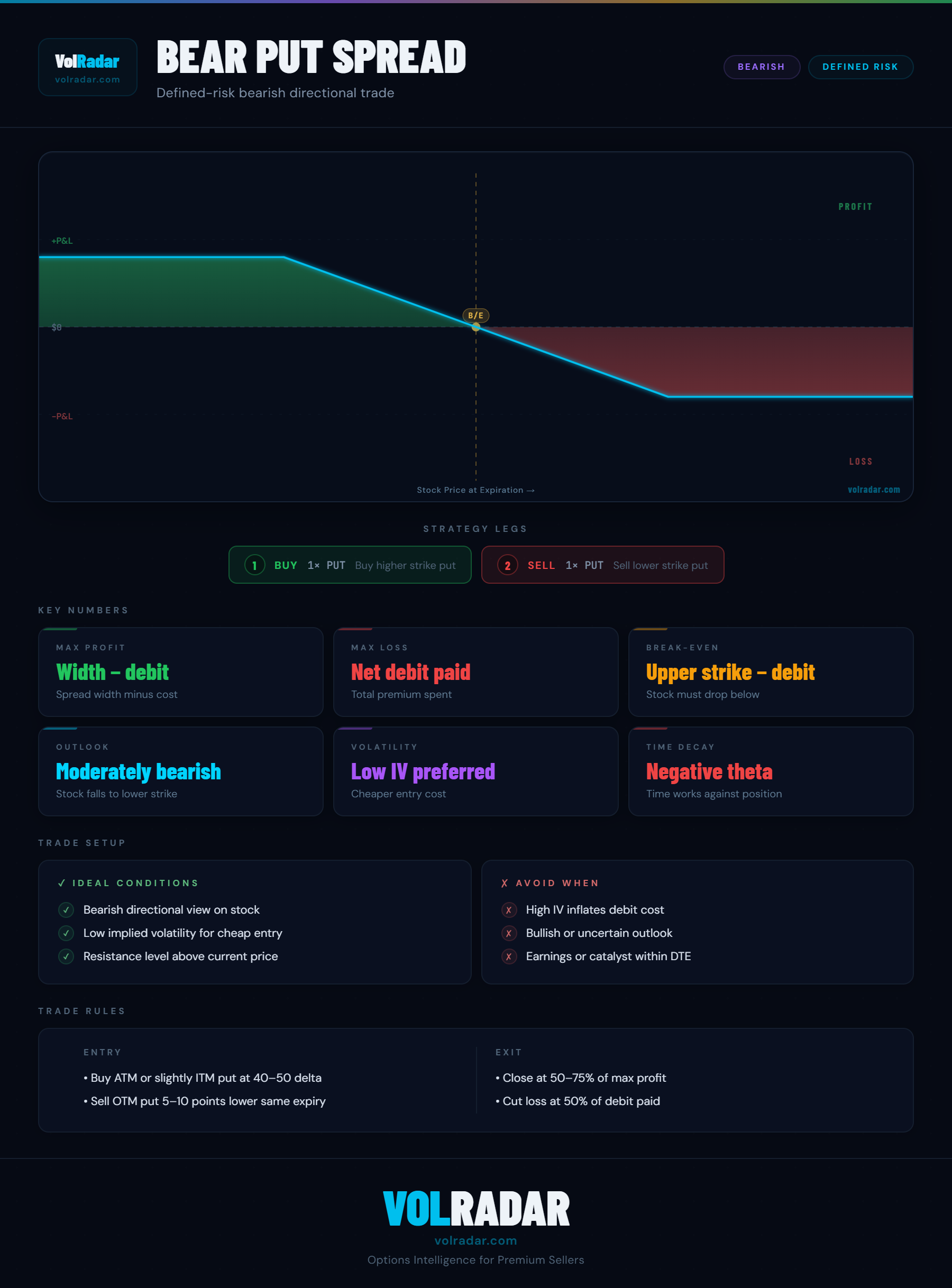
A bear put spread (also called a put debit spread) buys a put option at a higher strike and sells a put option at a lower strike on the same expiration. The premium from the sold put partially offsets the cost of the bought put. The position profits when the stock falls below the breakeven. Max profit is capped at the spread width minus the debit paid. It is the bearish equivalent of a bull call spread.
How to set up a bear put spread
Buy a put at or slightly OTM (40–50 delta). Sell a put at a lower strike below where you expect the stock to fall (15–25 delta). Net debit is the maximum loss. Example: $100 stock, buy the $100 put for $4.00, sell the $95 put for $1.75, net debit $2.25. Max profit is $2.75 (spread width $5 minus debit $2.25). Breakeven is $97.75.
Bear put spread vs buying a single put
A long put has unlimited bearish profit potential but costs more and decays faster. A bear put spread reduces cost and theta decay but caps the downside profit. In high IV environments, bear put spreads are particularly attractive because the sold put collects elevated premium, making the spread cheaper. Use a long put when you expect a very large move; use a spread for moderate directional moves.
Risk and management
Max loss is the net debit paid. Max profit is the spread width minus the debit. Breakeven is the long put strike minus the net debit. Target 50–75% of max profit before expiration. If the stock moves sharply in your favor, close early rather than waiting for full profit — gamma risk increases near expiration. If the thesis changes, close the spread at 50% of max loss to preserve capital.