Loading...
Strategies
Bull Call Ladder — Options Strategy Explained
A bull call ladder buys one call and sells two calls at two higher strikes, all with the same expiration. It adds an uncovered short call to a bull call spread, so a large rally brings unlimited loss.
By Aigars PilmanisLast updated
Educational content. Not financial, investment, tax, or legal advice. Options involve risk and are not suitable for all investors. How we write & review this glossary.
Read the full guide
Bull Call Ladder — Ratio Spread for Bullish Scenarios
A bull call ladder buys a call and sells two higher-strike calls for a credit (or reduced debit). Where the profit zone sits, the risk if the stock rallies hard, and when ladders beat plain spreads.
Read the guide→A bull call ladder buys one call and sells one call at a higher strike and another call at a still higher strike, all with the same expiration. It is a bull call spread with an extra short call added on top: the extra premium lowers the cost, or can turn it into a credit, but above the highest strike the position is short one uncovered call, so the loss on a large rally is unlimited.
The position
Structure
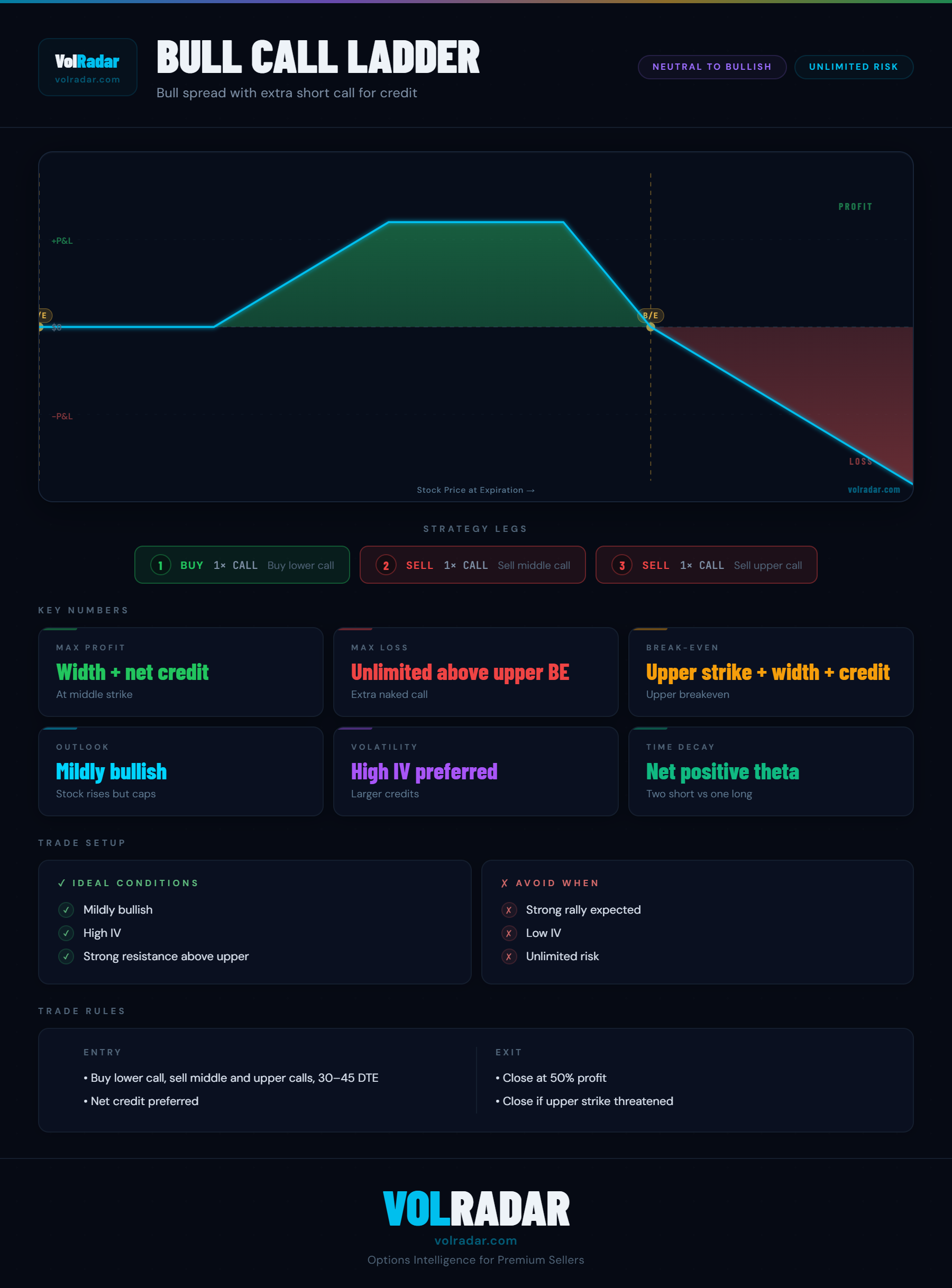
A bull-call ladder buys one in-the-money call and sells two higher-strike calls, turning bearish above the top short strike.
- Direction
- Bullish
- Drives outcome
- A rise toward the short strikes; above the top strike the extra short call is uncovered.
- Risk type
- Undefined risk
VolRadar Lens
The ladder is bullish only up to a point: the best result comes if the stock finishes between the two short strikes, and beyond the upper breakeven a stronger rally means a larger loss.
Visual ReferencePayoff structure and strike placementShowHide
Why It Matters
The ladder shows how selling extra premium changes a position's shape. Compared with a plain bull call spread on the first two strikes, the additional short call lowers the cost, which raises the maximum profit by that call's premium, but confines the maximum to the range between the two short strikes and removes the cap on losses: a stock that runs far past the upper strike turns a bullish trade into a losing one. The trade-off is between a cheaper entry and open-ended risk on a sharp rally, which is why the structure is described as undefined-risk.
How It Works
Buy a call at strike K1, sell a call at K2 and sell another call at K3, with K1 < K2 < K3 and one expiration. Net cost = premium of the K1 call - premiums of the K2 and K3 calls; it can be a small debit or a credit. At expiration: below K1 all calls expire worthless and the result is minus the debit (or plus the credit). Between K1 and K2 the long call gains one-for-one. Between K2 and K3 the gain is fixed at the maximum: (K2 - K1) minus the net debit, or plus the net credit. Above K3 the second short call is uncovered, so the position loses $1 per share for every $1 the stock rises; the upper breakeven is K3 plus the maximum profit. Dollar amounts are per-share figures times the contract multiplier (100 for standard US equity options). Because one short call is uncovered, the broker will require approval for uncovered call writing and margin under FINRA and exchange rules, and short American-style calls can be assigned early.
Example
Hypothetical, stock at $100, one expiration: buy the $100 call for $6.00, sell the $110 call for $2.50 and sell the $120 call for $0.90. Net debit = 6.00 - 2.50 - 0.90 = $2.60 per share, $260 per ladder. Maximum profit between $110 and $120: (110 - 100) - 2.60 = $7.40, or $740. Lower breakeven: 100 + 2.60 = $102.60. Upper breakeven: 120 + 7.40 = $127.40. At $130: long call 30.00, short $110 call -20.00, short $120 call -10.00, so 30 - 20 - 10 - 2.60 = -$2.60, a $260 loss; at $140 the loss is $1,260, and it keeps growing with the stock. Below $100 the loss is the $260 debit.
Common Mistakes
Treating the ladder as a cheaper bull call spread with the same risk: above the upper breakeven the loss is unlimited. Assuming a strong rally is good for a bullish position. Overlooking margin and approval requirements for the uncovered call. Ignoring early assignment on the short calls, especially when they are in the money before an ex-dividend date. Reading 'net credit' as 'no risk': a credit ladder still loses on a large rally.
Is the market paying premium sellers today?
The SPY Premium Window study tracks when systematic option selling has historically been compensated — recomputed daily from market close. Free to read, no account needed.
Frequently Asked Questions
What is the trade thesis behind a bull call ladder?
A moderately bullish view with a ceiling: the position does best if the stock finishes between the two short strikes at expiration, and the second short call lowers the cost compared with a bull call spread. It is not designed for a strong rally, which produces losses above the upper breakeven.
When does a bull call ladder reach maximum profit?
At expiration with the stock anywhere between the middle and upper strikes. The maximum is the distance between the long strike and the lower short strike, minus the net debit or plus the net credit.
What is the risk of a bull call ladder?
Above the highest strike the position is net short one call, so losses grow one-for-one with the stock and have no cap. Below the long strike the loss is limited to the net debit, and with a net credit there is no loss below the long strike.
How is a bull call ladder different from a bull call spread?
A bull call spread buys one call and sells one higher-strike call, so both its gain and its loss are capped. The ladder adds a second, higher short call: more premium and a higher maximum profit, but only between the two short strikes, and unlimited loss on a large rally.
General references
General references for this topic area, not citations for the specific figures above. VolRadar is not affiliated with these organizations.
The information about Bull Call Ladder above is for educational purposes only and is not financial advice. Read our full investment disclaimer.
Understand options faster.
One term, one worked example, one real ticker. Every Sunday. No jargon.
One email per week, no drip campaigns · Unsubscribe anytime