Loading...
Strategies
Bull Put Spread — Options Strategy Explained
A bull put spread sells a higher-strike put and buys a lower-strike put at the same expiration for a net credit.
By Aigars PilmanisLast updated
Educational content. Not financial, investment, tax, or legal advice. Options involve risk and are not suitable for all investors. How we write & review this glossary.
Read the full guide
Bull Put Spread — Collect Premium with a Bullish Bias
A bull put spread sells a put and buys a lower-strike put — defined-risk credit trade for a bullish view. Strike selection, breakevens, and how IV Rank changes the math.
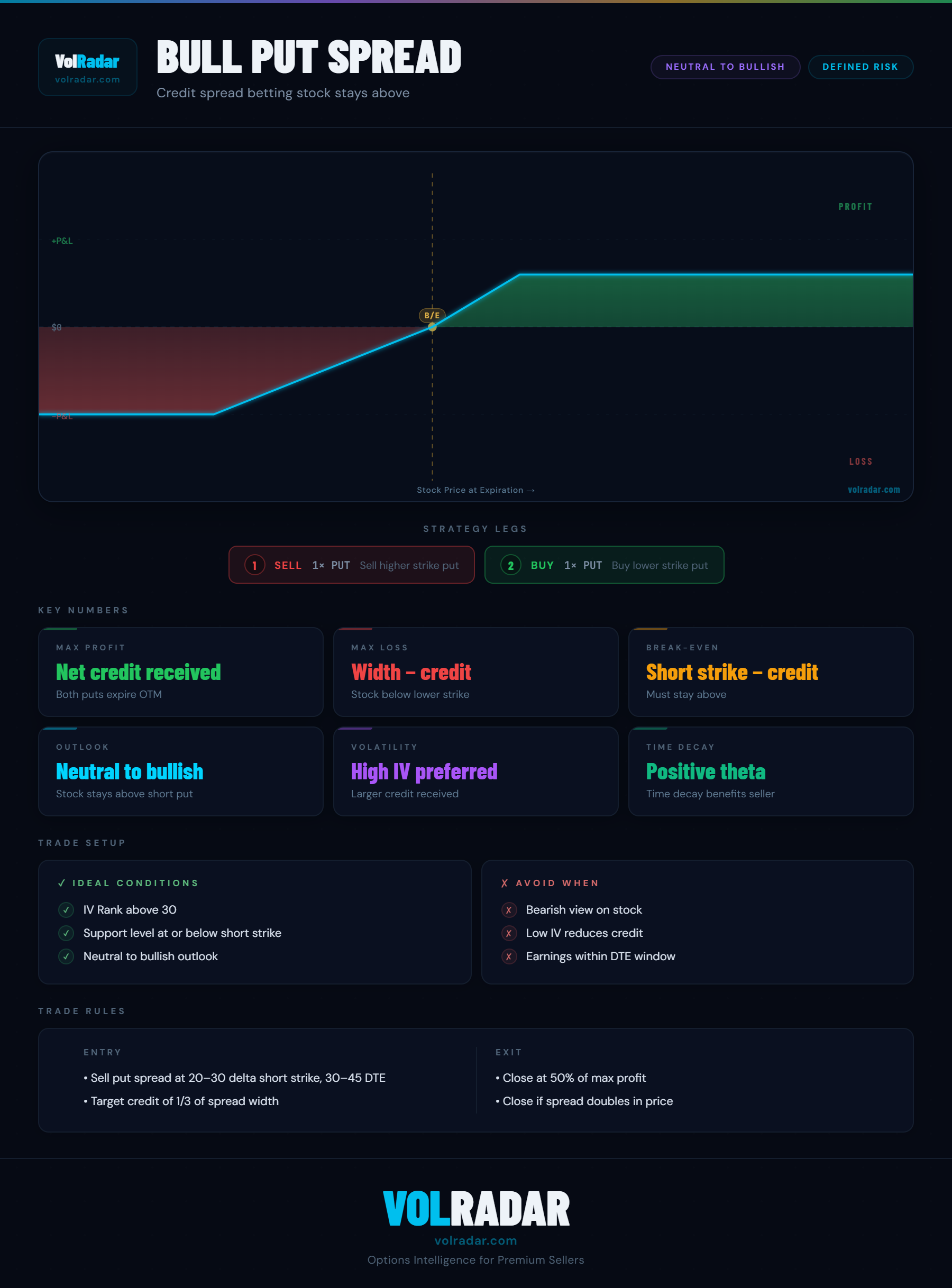
Read the guide→A bull put spread, also called a put credit spread, sells a put at a higher strike and buys a put at a lower strike on the same underlying and expiration, so it opens for a net credit. Its maximum gain is that credit and its maximum loss is the strike width minus the credit, so both are limited; it generally profits if the stock holds steady or rises.
The position
Direction
Bullish
- Max profit
- Net credit
- Max loss
- Spread width minus credit
- Risk type
- Defined (net credit)
VolRadar Lens
- Same as
- Put Credit Spread
The long lower-strike put is what limits the loss: without it the position is a short put, whose loss is much larger, though still bounded because a stock price cannot fall below zero.
Visual ReferencePayoff structure and strike placementShowHide
Why It Matters
A bull put spread is a limited-risk way to take a position that profits if the stock holds steady or rises. The credit is received when the position is opened and is also the most it can earn; the long put caps the loss of a short put at a known maximum. That makes the worst case calculable at entry, before commissions: the strike width minus the credit, times the multiplier.
How It Works
Sell a put at the higher strike (A) and buy a put at the lower strike (B), same expiration. Because the short put has the higher strike it is worth more than the long put, so the position receives a net credit. Maximum gain equals the credit and is reached if the stock finishes at or above A, when both puts expire worthless. Maximum loss equals the strike width (A minus B) minus the credit and is reached if the stock finishes at or below B, where the long put offsets further losses on the short put. Breakeven at expiration is A minus the credit. Between B and A the result is the credit minus (A minus the stock price). The Options Industry Council says the passage of time helps the position, though not quite as much as it helps a plain short put, and that the effect of a volatility change is slight, all else equal, because the two options' sensitivities partly offset. Early assignment of the short put is possible at any time and generally occurs when the put is deep in the money; covering the assignment with the long put may require financing a long stock position for one business day. Holding the spread into expiration adds risk because whether the short put was assigned may not be known until the following Monday. On the same two strikes, the bull call spread has approximately the same payoff once the cost of carry is taken into account; the difference is the timing of the cash flows.
Example
Hypothetical, per share, with standard 100-share contracts and the stock near 100: sell the 100 put at 3.40 and buy the 95 put at 1.60, same expiration. Net credit = 3.40 - 1.60 = 1.80 ($180 per spread). Strike width = 5.00. Maximum gain = $180, reached at or above 100. Maximum loss = (5.00 - 1.80) x 100 = $320, reached at or below 95. Breakeven = 100 - 1.80 = 98.20. At 97 at expiration the short put is worth 3.00 and the long put 0, so the result is 1.80 - 3.00 = -1.20 (-$120). A short 100 put on its own, collecting 3.40, would lose (100 - 3.40) x 100 = $9,660 if the stock fell to zero, against the spread's $320 limit. Commissions are not included.
Common Mistakes
Treating the credit as a profit already earned: it is the maximum gain, kept in full only if the stock finishes at or above the higher strike. Confusing the maximum loss with the credit: the maximum loss is the strike width minus the credit. Ignoring early assignment of the short put, and the uncertainty about assignment until the Monday after expiration if the spread is held through expiry. Forgetting the multiplier and commissions on two legs: dollar results are per-share figures times the contract multiplier (100 for standard US equity options). Mixing up the structures: a bull call spread is the debit version, which pays up front.
Is the market paying premium sellers today?
The SPY Premium Window study tracks when systematic option selling has historically been compensated — recomputed daily from market close. Free to read, no account needed.
Frequently Asked Questions
How is a bull put spread different from selling a put on its own?
A short put on its own has a large loss if the stock falls, bounded only because a stock price cannot go below zero. The bull put spread adds a lower-strike long put, which caps the loss at the strike width minus the credit. The price of that protection is a smaller credit.
When does a bull put spread reach maximum profit?
At expiration, if the stock finishes at or above the higher (short put) strike, both puts expire worthless and the full credit is kept. In the example that is $180 per spread.
What is the maximum loss on a bull put spread?
The strike width minus the credit received, multiplied by the contract multiplier, reached if the stock finishes at or below the lower strike. In the example it is (5.00 - 1.80) x 100 = $320.
What is the breakeven price of a bull put spread?
The short put strike minus the net credit received. In the example it is 100 - 1.80 = 98.20: above that at expiration the spread is profitable, and below it the spread loses.
Can a bull put spread be assigned early?
Yes. The short put can be assigned at any time, and the Options Industry Council says early assignment generally occurs when a put is deep in the money. Using the long put to cover the assignment may require financing a long stock position for one business day, and corporate events such as a merger or special dividend can upset normal expectations.
General references
General references for this topic area, not citations for the specific figures above. VolRadar is not affiliated with these organizations.
The information about Bull Put Spread above is for educational purposes only and is not financial advice. Read our full investment disclaimer.
Understand options faster.
One term, one worked example, one real ticker. Every Sunday. No jargon.
One email per week, no drip campaigns · Unsubscribe anytime