Loading...
Greeks
Charm — Options Greek Explained
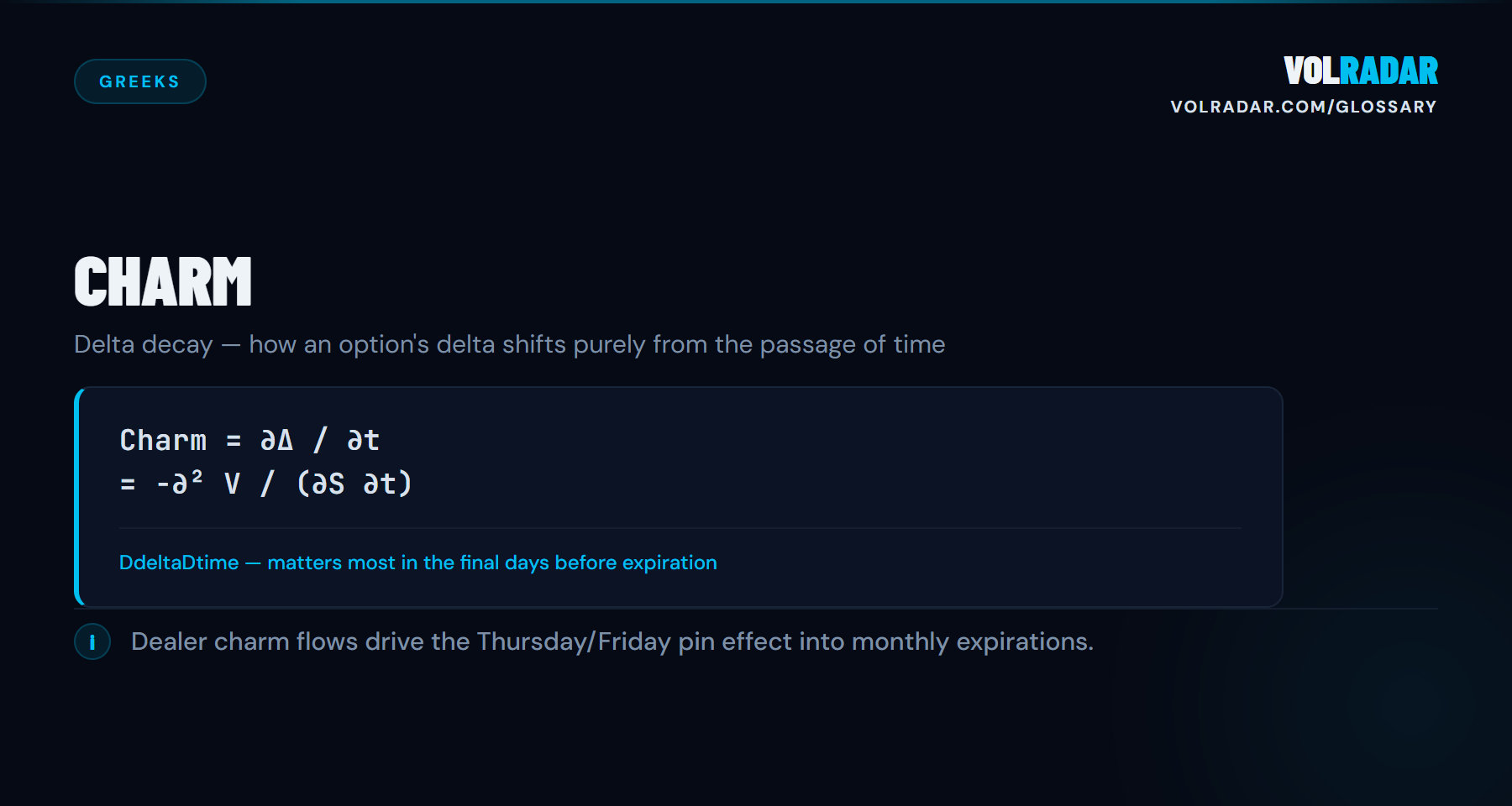
Charm, also called delta decay, is the rate at which an option's delta changes as time passes, with price and volatility held constant.
By Aigars PilmanisLast updated
Educational content. Not financial, investment, tax, or legal advice. Options involve risk and are not suitable for all investors. How we write & review this glossary.
Charm, also called delta decay or DdeltaDtime, is the rate at which an option's delta changes as time passes, with the underlying price and implied volatility held constant. As expiration approaches, out-of-the-money options' deltas drift toward 0 and in-the-money options' deltas drift toward 1 for calls or -1 for puts, while at-the-money call deltas stay near 0.50; charm measures how fast that drift happens.
Video explainer8:25
Watch: Charm Explained
8:25 walkthrough — definition, mechanics, worked example, and common mistakes for Charm.
What to remember from this video
Charm, or delta decay, is the silent force that shifts your delta due to time passing, even when the underlying asset remains static.
Key Insights From The Video
- Charm quantifies how delta changes purely due to time, not price movement.
- Under common simplified assumptions with price held fixed, OTM options tend to see delta drift toward zero as expiration nears.
- Under the same assumptions, ITM options tend to see the absolute value of delta move toward 1, toward +1 for calls and -1 for puts.
- Charm effects can become larger as expiration nears, especially near the money.
- Weekend charm drift can alter your hedge by Monday without a price change.
Read the complete video explanation~289 words · 1 min read
Charm is a higher-order Greek that affects your delta as time passes, even if the underlying asset price doesn't change. It's a silent force that can alter your risk profile overnight, particularly over weekends or holidays when the market is closed.
Imagine you've delta-hedged your position perfectly by Friday's close. You log off for the weekend, confident in your market-neutral stance. Yet, come Monday, your hedge is off, and you're exposed to directional risk. This happens because of charm, which causes your delta to drift purely due to time passing.
Charm measures how an option's delta changes as time progresses. The direction of charm depends on moneyness, time to expiration, volatility, interest rates, dividends and the sign convention used. Under common simplified assumptions with the underlying price held fixed, out-of-the-money (OTM) options tend to see delta drift toward zero as expiration approaches, while in-the-money (ITM) options tend to see the absolute value of delta drift toward 1, that is toward +1 for calls and -1 for puts.
The effect of charm can be more pronounced as expiration nears, especially for options near the money. During this period, charm can shift delta noticeably from day to day, making a carefully sized hedge oversized or undersized.
Market makers may factor charm into their end-of-day hedges, especially before weekends, anticipating the delta drift that will occur over the weekend.
Traders who monitor charm often review end-of-day charm exposure, particularly on Fridays, and some adjust delta to offset the expected drift.
Charm isn't just a risk; it can work in either direction. For short OTM positions, charm tends to move the position's delta toward zero as time passes, though this does not remove the risk of losses if price moves toward the strike.
VolRadar Lens
- Also called
- Delta decay or DdeltaDtime
- Measures
- How delta changes as time passes
A charm figure only makes sense with its time convention attached: with no interest or dividends, an out-of-the-money call shows negative charm per calendar day passed, a model that differentiates with respect to time remaining shows the same number with a positive sign, and models also differ on how weekends count.
Why It Matters
Delta is the hedge ratio, so anything that changes delta changes the hedge. Charm is the part of that change caused only by the passage of time: a position that is delta-neutral today can carry directional exposure tomorrow even if the stock and implied volatility do not move. The effect is small for long-dated options and grows near expiration for strikes near, but not at, the current price, which is why charm is mainly discussed for short-dated positions and for market makers' hedged books. For a short out-of-the-money option, charm shrinks the position's delta as time passes while the price holds; if the price moves toward the strike, gamma can outweigh that drift.
How It Works
Charm is the mixed second derivative of the option price with respect to the underlying price and time, which is the same as the derivative of delta with respect to time. This page quotes charm as the change in delta for one day passed (dDelta/dt). Under that convention, and with no interest or dividends, an out-of-the-money call has negative charm, because its delta falls toward 0, and an out-of-the-money put has positive charm, because its negative delta rises toward 0; in-the-money options show the opposite signs. The exception is a narrow band of prices just above the strike, where a slightly in-the-money call and a slightly out-of-the-money put both show negative charm, because in this model a call and a put with the same strike have the same charm. With interest rates or dividends, carry terms enter the formula and can change these signs. Software that differentiates with respect to time remaining to expiration (dDelta/dT) reports the same values with the opposite sign. In the Black-Scholes model with no interest or dividends, charm is close to zero for an option whose strike is near the current price, because its delta stays near 0.50, and it is largest in size for strikes roughly one standard deviation away (implied volatility times the square root of the time remaining); for strikes much farther away it fades again, because those deltas are already near 0 or 1. For a fixed strike away from the price, charm first grows as expiration approaches and then fades once that option's delta has settled near 0 or 1. Time units matter: pricing models differ in whether they decay options over calendar days, including weekends, or over trading days, so the charm reported across a weekend differs between models.
Example
Hypothetical: a trader is short 10 puts with a $95 strike on a stock at $100, with implied volatility 30%, no interest or dividends, 5 calendar days to expiration, time measured in 365-day years and 100 shares per contract. Each put's Black-Scholes delta is about -0.0697, so the short position's delta is -10 x 100 x (-0.0697) = about +69.7 shares, hedged by shorting about 70 shares. One day later, with the price and implied volatility unchanged, each put's delta is about -0.0496 and the position delta is about +49.6 shares, so the trader buys back about 20 shares to stay neutral: each put's charm over that day is about +0.020. For comparison, a $100-strike call on the same stock has a delta of about 0.507 at 5 days and 0.506 at 4 days, a change of about -0.001.
Common Mistakes
Treating charm as having one sign: it is negative or positive depending on whether the option is a call or a put, whether it is in or out of the money, and which time convention the software uses. Confusing charm with theta: theta is the change in the option's price over time, charm the change in its delta over time. Confusing charm with gamma: gamma measures the change in delta from a price move, charm the change from the passage of time. Comparing charm figures from different platforms without checking whether they count calendar days or trading days. Assuming an at-the-money option's delta decays quickly as expiration nears: its delta stays near 0.50 while its gamma rises.
See the Greeks on a real position
The options profit calculator plots how price, time and volatility move a position before you commit to it.
Frequently Asked Questions
What does the charm Greek measure on a listed option?
Charm measures how much an option's delta changes as time passes, usually quoted per day, with price and implied volatility unchanged. As expiration approaches it pulls out-of-the-money deltas toward 0 and in-the-money deltas toward 1 or -1, so it tells a holder how quickly the option's directional exposure shrinks or grows from time alone.
Why does charm matter for dealer hedging?
A market maker that keeps its book delta-hedged has to trade the underlying whenever delta changes, including changes caused only by time. Charm sizes that time-driven part of the rebalancing. Whether the resulting trades are purchases or sales depends on which options the dealer is long or short, which outside observers can only estimate.
How does the charm Greek relate to expiration pin risk?
Near expiration, options with strikes close to the current price have the most sensitive deltas: gamma is highest at the strike and charm is largest just away from it, so small changes in price or time can change how much stock a hedger needs. A study of U.S. stock options by Ni, Pearson and Poteshman found that closing prices of optionable stocks cluster at strike prices on expiration dates and attributed part of this to hedge rebalancing by option market makers; the study does not separate charm from gamma and other effects.
Is charm a useful Greek for retail premium sellers?
Charm is usually largest in size for short-dated options with strikes near, but not at, the current price, so it matters most for short-dated positions, where a delta measured one day can be noticeably different the next. For longer-dated positions the daily drift is small compared with the effect of price moves. It can be approximated with a pricing model by computing the option's delta for the current time to expiration and for one day less, with price and volatility unchanged.
What is charm exposure in dealer-positioning data?
Charm exposure is an estimate of how much the combined delta of dealers' options positions changes per day from time alone: each option's charm times the estimated dealer position times the contract multiplier, summed across strikes and expirations. Because dealer positions are not public, its sign and size depend on assumptions about who holds each side of each option.
General references
General references for this topic area, not citations for the specific figures above. VolRadar is not affiliated with these organizations.
Visual ReferenceHow Charm responds to price, time, and volatilityShowHide
The information about Charm above is for educational purposes only and is not financial advice. Read our full investment disclaimer.
Understand options faster.
One term, one worked example, one real ticker. Every Sunday. No jargon.
One email per week, no drip campaigns · Unsubscribe anytime