Loading...
Strategies
Covered Combo — Options Strategy Explained
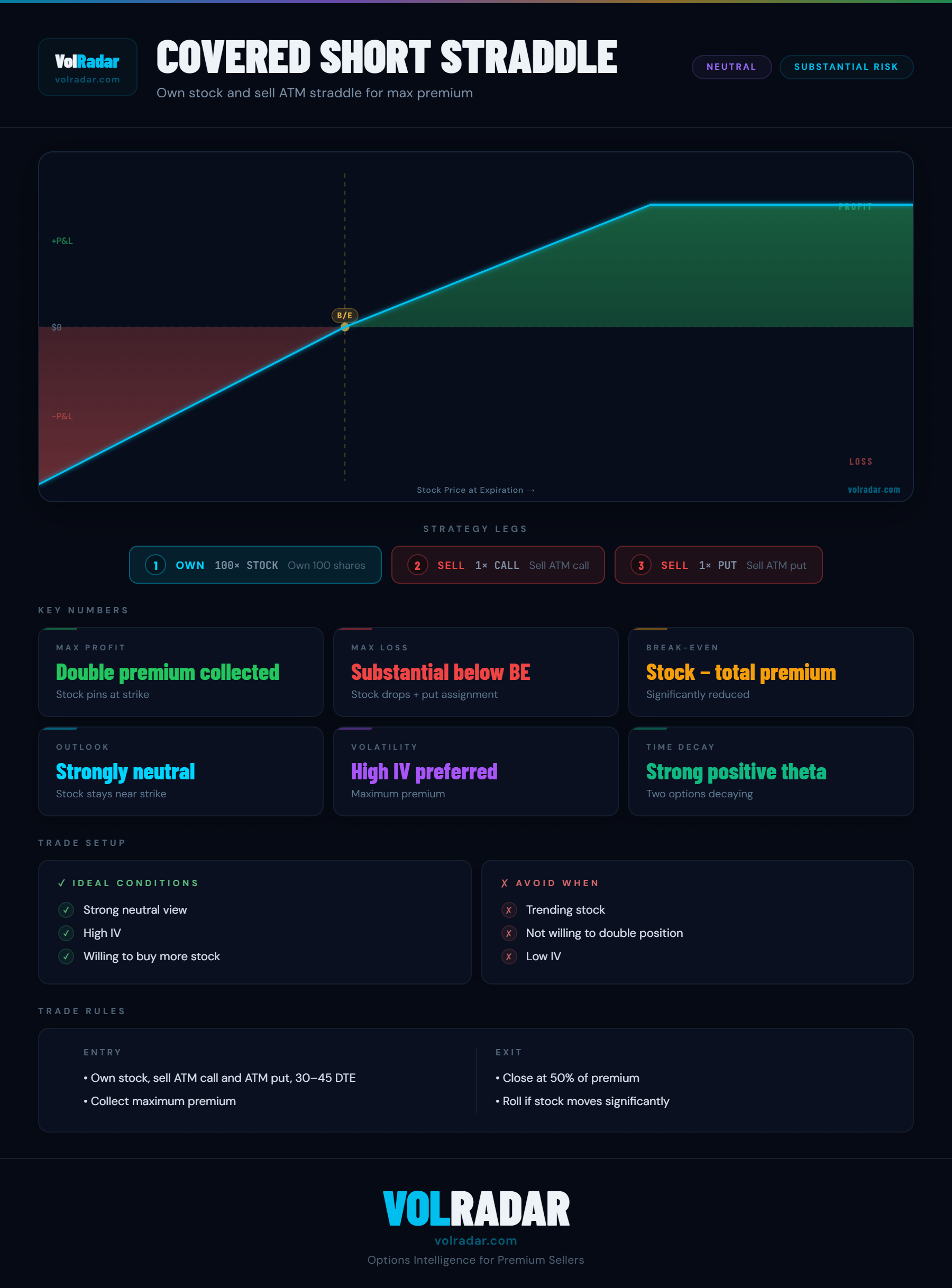
A covered combo holds long stock, a short OTM call, and a short OTM put.
By Aigars PilmanisLast updated
Educational content. Not financial, investment, tax, or legal advice. Options involve risk and are not suitable for all investors. How we write & review this glossary.
A covered combo, also called a covered combination or covered strangle, is a position of long stock plus a short out-of-the-money call and a short out-of-the-money put, usually on the same expiration. It combines a covered call with a cash-secured put: the call is covered by the shares, while the put is backed by cash set aside to buy more shares if it is assigned.
The position
Structure
A covered combo holds long stock, a short OTM call, and a short OTM put.
- Direction
- Neutral
- Drives outcome
- More premium than a covered call, plus an obligation to buy 100 more shares at the put strike.
- Risk type
- See structure
VolRadar Lens
Only the call is covered: the short put adds a second block of long-stock exposure, so in a sharp decline the loss builds on the original shares and the newly assigned ones at the same time.
Visual ReferencePayoff structure and strike placementShowHide
Why It Matters
The covered combo is a way to collect option premium on both sides of a stock that an investor already owns, for someone willing either to sell the shares higher or to buy more lower. Compared with a covered call on the same shares, it adds a second premium, but also a second source of downside: the investor carries the risk of the existing shares plus the obligation to buy more.
How It Works
Own 100 shares, sell one out-of-the-money call and sell one out-of-the-money put. For example, with the stock at $100: sell a 110 call and a 90 put and collect both premiums. If the stock is above the call strike at expiration, the call is likely to be assigned and the shares are sold at the call strike, which caps the upside. If the stock is below the put strike, the put is likely to be assigned and the investor, as the put's writer, buys another 100 shares at the put strike, doubling the position. Between the two strikes, both options can expire worthless and the premiums are kept. Because the investor must be able to buy the extra shares, the short put is typically cash-secured (or carried on margin), so the position ties up more capital than a covered call.
Example
Hypothetical figures. An investor owns 100 shares bought at $52, with the stock at $52. They sell a 45-day $57 call for $1.20 and a 45-day $48 put for $1.05, collecting $1.20 + $1.05 = $2.25 per share, or $225. Securing the put takes $48 x 100 = $4,800 in cash. - Stock between $48 and $57 at expiration: both options expire worthless; the $225 is kept and the shares are still held. The break-even at expiration is $52 - $2.25 = $49.75 per share; below it, the loss on the shares exceeds the premiums. - Stock above $57: the shares are called away at $57; maximum gain = $57 - $52 + $2.25 = $7.25 per share, or $725. - Stock below $48: the put is assigned and the investor owns 200 shares at an average net cost of ($52 + $48 - $2.25) / 2 = $48.875 per share. If the stock fell to zero, the loss would be $52 + $48 - $2.25 = $97.75 per original share, or $9,775.
Common Mistakes
Treating the short put as covered: long stock covers a short call, not a short put, so the put needs cash or margin behind it. Sizing the position for 100 shares when assignment can leave 200. Ignoring volatility: a rise in implied volatility, other things equal, raises the value of both short options and works against the position. Forgetting that an assigned call removes the shares, so the remaining short put is then a stand-alone cash-secured put.
Is the market paying premium sellers today?
The SPY Premium Window study tracks when systematic option selling has historically been compensated — recomputed daily from market close. Free to read, no account needed.
Frequently Asked Questions
What is a covered combo in options trading?
Long stock combined with a short out-of-the-money call and a short out-of-the-money put, usually on the same expiration. It is a covered call plus a cash-secured put on the same stock, and is also called a covered combination or covered strangle.
What is the maximum gain and loss on a covered combo?
Maximum gain is the call strike minus the stock purchase price plus the premiums received. Maximum loss is the stock purchase price plus the put strike minus the premiums received, per share, reached if the stock falls to zero after the put is assigned. The loss side is substantial.
How does a covered combo differ from the wheel?
The wheel usually alternates: cash-secured puts while holding no shares, then covered calls after assignment. A covered combo holds shares and runs a short call and a short put at the same time, so both premiums are collected together and assignment is possible on either side.
Is a covered combo the same as a covered strangle?
Yes. The Options Industry Council lists the strategy as the covered strangle, also called the covered combination.
General references
General references for this topic area, not citations for the specific figures above. VolRadar is not affiliated with these organizations.
The information about Covered Combo above is for educational purposes only and is not financial advice. Read our full investment disclaimer.
Understand options faster.
One term, one worked example, one real ticker. Every Sunday. No jargon.
One email per week, no drip campaigns · Unsubscribe anytime