Loading...
Strategies
Double Diagonal — Options Strategy Explained
A double diagonal combines a call diagonal and a put diagonal on the same underlying. It sells near-term options inside and buys longer-dated options at wider strikes, so it resembles an iron condor whose long options expire later.
By Aigars PilmanisLast updated
Educational content. Not financial, investment, tax, or legal advice. Options involve risk and are not suitable for all investors. How we write & review this glossary.
Read the full guide
Double Diagonal — Two Diagonal Spreads for Range-Bound Income
A double diagonal combines a bullish diagonal and a bearish diagonal spread for premium on both sides. How it compares to iron condors and calendar spreads, and the management quirks across two expirations.
Read the guide→A double diagonal is two diagonal spreads on the same underlying, one with calls and one with puts: sell a nearer-term call and buy a later-expiring call at a higher strike, and sell a nearer-term put and buy a later-expiring put at a lower strike. It resembles an iron condor whose long options expire later than the short options, and it aims to profit if the underlying stays between the short strikes while the short-dated options lose time value.
The position
Structure
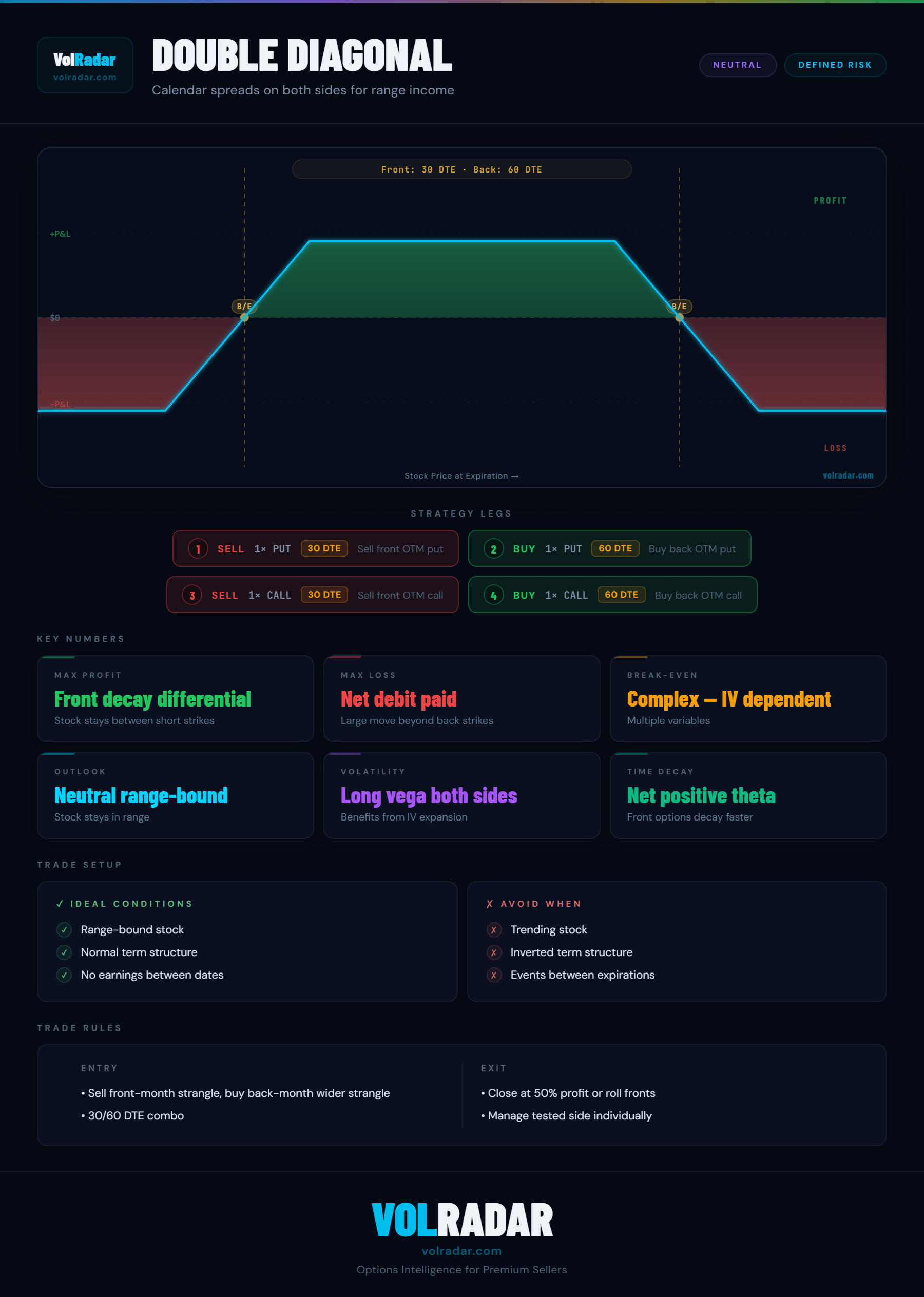
A double diagonal uses two diagonal spreads at different strikes, combining directional bias and time decay on both the call and put sides.
- Direction
- Neutral
- Drives outcome
- Combines the time-decay profile of calendars across both sides of the underlying.
- Risk type
- See structure
VolRadar Lens
Because the long options outlive the short ones, a double diagonal cannot be valued from a payoff diagram alone: its result at the front expiration depends on what the remaining long options are worth then, which depends on implied volatility at that time.
Visual ReferencePayoff structure and strike placementShowHide
Why It Matters
The double diagonal sits between an iron condor and a double calendar. Compared with an iron condor, the later-dated long options cost more but keep value after the short options expire and react more to changes in implied volatility. Compared with a double calendar, which uses the same strike for each short and long pair, moving the long strikes outward changes the cost and widens the range between the long strikes. The trade-offs between cost, range and volatility exposure are set by the choice of strikes and expirations.
How It Works
Choose two expirations. In the nearer one, sell an out-of-the-money call and an out-of-the-money put. In the later one, buy a call with a higher strike than the short call and a put with a lower strike than the short put. The short options lose time value faster as their expiration approaches, which helps the position while the underlying stays between the short strikes. The long options keep time value after the front expiration and give the position net long exposure to implied volatility (positive vega) in most configurations, because later-dated options generally have more vega than nearer-dated ones; a rise in implied volatility tends to help and a fall tends to hurt. The position is defined-risk while the long options are held: on the tested side the loss at the front expiration is limited to roughly the distance between the short and long strikes plus any net debit, less the time value the long option still has. It can be opened for a net debit or a net credit depending on the strikes and expirations chosen. At the front expiration the short options are closed, rolled to a new expiration, or allowed to expire, and the long options are then sold or kept as a separate position.
Example
Hypothetical, underlying at $100: sell a 30-day $105 call and a 30-day $95 put, and buy a 60-day $110 call and a 60-day $90 put. If the underlying is near $100 when the 30-day options expire, both short options expire worthless, and the position is worth whatever the two 60-day options are then worth. If it is at $112 instead, the short $105 call is worth $7.00 at expiration, while the 60-day $110 call is worth at least its $2.00 intrinsic value plus its remaining time value; the net result depends on that time value, on implied volatility, and on the prices paid and received at entry. No single P&L figure can be stated without those inputs.
Common Mistakes
Treating the maximum loss as fixed at entry: it depends on the long options' value at the front expiration. Ignoring that a fall in implied volatility can hurt even if the underlying stays in range. Forgetting that the short options are American-style on most equities and can be assigned early, particularly a short call before an ex-dividend date. Underestimating execution costs on a four-leg position, especially when rolling.
Is the market paying premium sellers today?
The SPY Premium Window study tracks when systematic option selling has historically been compensated — recomputed daily from market close. Free to read, no account needed.
Frequently Asked Questions
What is a double diagonal spread in options?
It combines a call diagonal and a put diagonal: short near-term out-of-the-money call and put, and long later-dated call and put at strikes further out of the money. It is a time spread with a range in between, similar in shape to an iron condor.
How does a double diagonal differ from an iron condor?
An iron condor uses one expiration for all four options. A double diagonal buys its wings in a later expiration, so the long options keep value after the short options expire and the position usually has more exposure to implied volatility.
How does a double diagonal differ from a double calendar?
A double calendar pairs each short option with a long option at the same strike in a later expiration. A double diagonal moves the long strikes further out of the money than the shorts, which changes the cost and the shape of the profit range.
What is the maximum loss on a double diagonal?
It cannot be stated exactly at entry, because the long options are still alive at the front expiration. On the tested side, the loss at the front expiration is limited to roughly the strike distance between the short and long options plus any net debit, reduced by the long option's remaining time value.
General references
General references for this topic area, not citations for the specific figures above. VolRadar is not affiliated with these organizations.
The information about Double Diagonal above is for educational purposes only and is not financial advice. Read our full investment disclaimer.
Understand options faster.
One term, one worked example, one real ticker. Every Sunday. No jargon.
One email per week, no drip campaigns · Unsubscribe anytime