Loading...
Mechanics
European-Style Option — Options Order Mechanics Explained
A European-style option can be exercised only at expiration, so its seller cannot be assigned before expiration.
By Aigars PilmanisLast updated
Educational content. Not financial, investment, tax, or legal advice. Options involve risk and are not suitable for all investors. How we write & review this glossary.
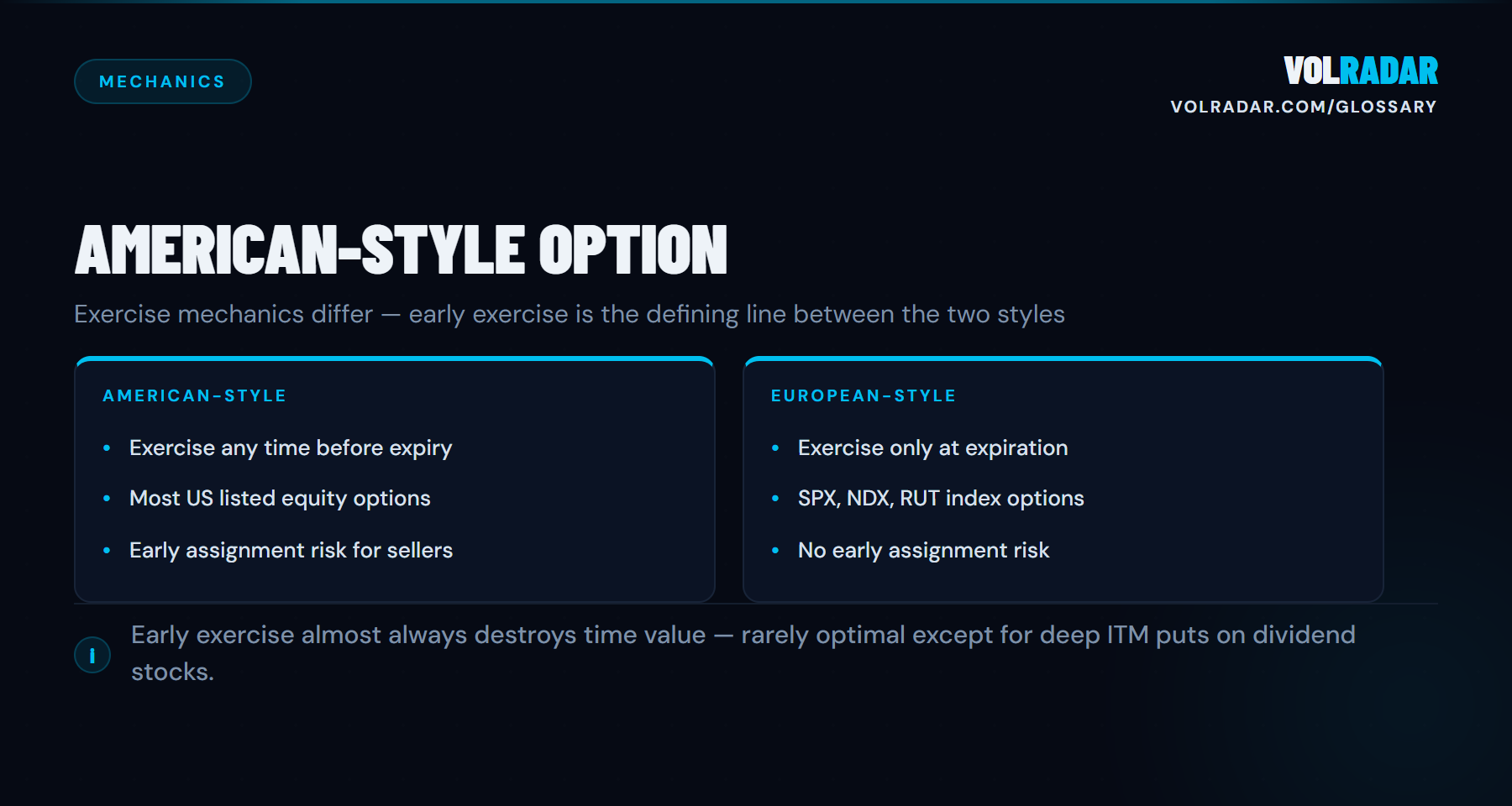
A European-style option is an option that can be exercised only at expiration, not before. Because the holder cannot exercise early, the seller cannot be assigned early, although either side can still close the position with an offsetting trade before trading ends. Most US index options, including S&P 500 index options (SPX), are European-style; US equity options are generally American-style.
Video explainer7:10
Watch: European-Style Option Explained
7:10 walkthrough — definition, mechanics, worked example, and common mistakes for European-Style Option.
What to remember from this video
European-style options act like a locked vault, exercisable only at expiration, eliminating early assignment risk for traders.
Key Insights From The Video
- European-style options can only be exercised at expiration, protecting sellers from early assignment.
- SPX, NDX, and VIX are common European-style options with cash settlement.
- Some SPX series, such as the standard monthly, use AM settlement based on opening prices of component stocks.
- Other SPX series, such as weeklies, use PM settlement based on the closing price of the index.
- Cash settlement means no stock delivery, only a cash debit or credit.
Read the complete video explanation~266 words · 1 min read
European-style options serve as a protective shield for traders by allowing exercise only at expiration, never before. This structure eliminates the risk of early assignment, which can disrupt trading strategies and tie up capital unexpectedly.
For premium sellers, especially those managing complex spreads, early assignment can be a significant headache. European-style options, like those on the SPX, NDX, and VIX, provide a solution by ensuring that the option contract can only be exercised at expiration.
These options settle in cash, meaning no physical stock changes hands. This simplifies the process, as traders only deal with a cash debit or credit based on the final settlement price, avoiding the logistical challenges of stock delivery.
Some SPX options, such as the standard monthly series, use AM settlement, which calculates the settlement price based on the opening prices of all component stocks on expiration morning. This can lead to significant differences from the previous day's close, especially if news breaks overnight.
In contrast, other SPX series, such as weeklies, use PM settlement, which is based on the index's closing price on the day of expiration. This provides a more straightforward calculation for traders.
A practical example involves selling an SPX $5350/$5300 put spread. If the market drops mid-cycle, under American-style rules, you'd face assignment risk. However, with European-style SPX options, you can hold the position through expiration without fear of early assignment.
Traders must be cautious not to assume all index options are European-style. For example, OEX options are American-style, which involves different risks and settlement mechanics. Always verify the specific settlement style of the index product you're trading.
VolRadar Lens
- Definition
- An option contract exercisable only at expiration, never before, as with most US index options like SPX, NDX, and RUT.
- Use
- No early assignment risk, which removes one source of uncertainty for spread sellers on European-style index products.
A European-style option cannot be exercised before expiration, so a short position carries no early-assignment risk, but it still carries the full settlement outcome at expiration. Each product's contract specifications show its exercise style and whether it settles on the opening (AM) or closing (PM) index value.
Why It Matters
For sellers, European-style exercise removes early assignment: a short put spread on a European-style index cannot be broken apart by an early exercise of the short leg, and no stock position appears before expiration. Settlement risk remains. With AM settlement, the final value is computed from the next morning's opening prints after trading has stopped, and Cboe notes the special opening quotation can fall outside the index's open, high, low or close for that day.
How It Works
Exercise style sets when the holder may exercise. A European-style option can be exercised only at expiration; an American-style option can be exercised on any business day up to and including expiration. The style does not stop anyone from trading out of the position: either side can close with an offsetting transaction up to the last trading day.
In the US, equity options generally use American-style exercise, while index options can have either style; the majority of US-listed index options are European-style. Index options are usually cash-settled: no shares change hands, and exercise produces a cash payment. For SPX, the exercise-settlement amount is the amount by which the option is in the money at the exercise-settlement value (SET), multiplied by $100: SET minus the strike for a call, the strike minus SET for a put, and zero for an option that finishes out of the money.
The settlement value depends on the series:
| Settlement | Settlement value is based on | Trading ends |
|---|---|---|
| AM-settled (for example, standard monthly SPX) | Opening prices of the index's component stocks on expiration day (Cboe's special opening quotation, symbol SET) | The day before expiration |
| PM-settled (for example, SPXW) | Closing prices of the component stocks on expiration day | Expiration day |
Example
Hypothetical, illustrative figures. You sell one AM-settled SPX put with a 5,800 strike for $12.50, receiving $12.50 x 100 = $1,250. Days before expiration the index trades at 5,750, below the strike, but because the option is European-style it cannot be exercised and you cannot be assigned. Trading in the series ends the day before expiration. On expiration morning the settlement value (SET) is calculated at 5,780, so the put settles in cash for (5,800 - 5,780) x $100 = $2,000. Result: $1,250 - $2,000 = -$750 before commissions. Had SET been 5,810, above the strike, the put would expire worthless and the $1,250 premium would be kept.
Common Mistakes
Assuming every index option is European-style: index options can have either exercise style, so the specifications have to be checked. Assuming no early assignment means no risk: an in-the-money European option still settles for its full intrinsic value at expiration. Planning to exit an AM-settled option on expiration day: trading stops the day before. Assuming the prior day's close predicts the AM settlement value. Assuming 'European' means the option trades in Europe; the name describes only the exercise rule.
Frequently Asked Questions
What is a European-style option?
An option that can be exercised only at expiration. An American-style option, by contrast, can be exercised on any business day up to and including expiration. The name describes the exercise rule, not where the option trades.
Can you close a European-style option before expiration?
Yes. Exercise style limits only when the option can be exercised. Either side can close the position with an offsetting trade at any time up to the last trading day.
Are SPX options European-style?
Yes. Cboe states that SPX options can only be exercised at expiration and settle to cash; an in-the-money option pays the amount by which it is in the money at the settlement value (settlement value minus strike for a call, strike minus settlement value for a put), multiplied by $100, and an out-of-the-money option pays nothing.
Are all index options European-style?
No. According to the Options Industry Council, equity options generally use American-style exercise, while index options can have either American- or European-style exercise, although most US index options are European-style. Check each product's contract specifications.
What is the settlement risk on AM-settled European-style options?
AM-settled index options stop trading the day before expiration, and their settlement value is calculated from the opening prices of the component stocks on expiration morning. That value can differ from the prior close, and Cboe notes it can even fall outside the index's high-low range for the day.
General references
General references for this topic area, not citations for the specific figures above. VolRadar is not affiliated with these organizations.
Visual ReferenceVisual reference for European-Style OptionShowHide
The information about European-Style Option above is for educational purposes only and is not financial advice. Read our full investment disclaimer.
Understand options faster.
One term, one worked example, one real ticker. Every Sunday. No jargon.
One email per week, no drip campaigns · Unsubscribe anytime