Loading...
Strategies
Reverse Iron Condor — Options Strategy Explained
A reverse iron condor buys the inner call and put and sells the outer call and put, paying a net debit for a position that gains from a large move in either direction.
By Aigars PilmanisLast updated
Educational content. Not financial, investment, tax, or legal advice. Options involve risk and are not suitable for all investors. How we write & review this glossary.
A reverse iron condor is a four-option strategy on one underlying and one expiration that buys a call spread and a put spread outside the current price: it is long the inner call and inner put and short the outer call and outer put, for a net debit. It gains when the underlying finishes beyond either breakeven at expiration, and the most it can lose is the debit paid. The Options Industry Council (OIC) describes the same structure as a long condor (long iron condor).
The position
Structure
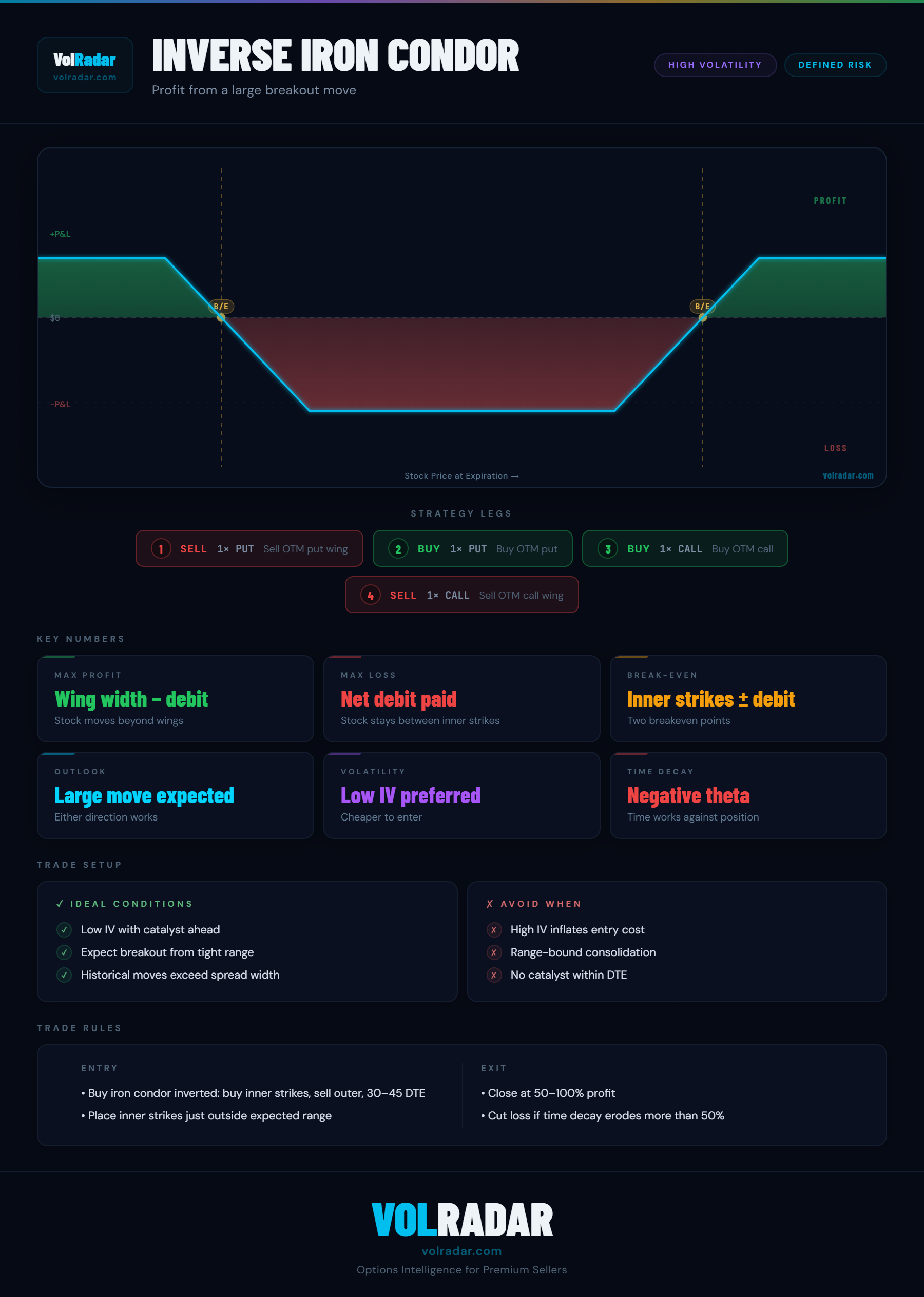
A reverse iron condor buys the inner strikes and sells the outer strikes, creating a debit position that pays off on a breakout in either direction.
- Direction
- Volatility play
- Drives outcome
- A breakout beyond either long strike; the loss is capped at the debit paid.
- Risk type
- Defined risk
VolRadar Lens
The most that can be lost is the debit, and both breakevens are fixed when the position is opened. Profit starts beyond a breakeven, which sits past the long strikes, and is largest beyond the short strikes.
Visual ReferencePayoff structure and strike placementShowHide
Why It Matters
A reverse iron condor is a defined-risk way to hold a position that gains when the underlying moves a long way: the loss is limited to the debit and the short options are covered by the long ones. Compared with an outright long strangle, OIC's description shows what changes: a wider short strangle is added outside, which lowers the net cost and caps the gain. It is the opposite of an iron condor: one gains when the underlying leaves the range, the other when it stays inside. Because a large enough move is needed to pass a breakeven, a small move, or a finish between the long strikes, leaves the position at a loss.
How It Works
Take four strikes K1 < K2 < K3 < K4 with the same expiration. Buy the K2 put, sell the K1 put, buy the K3 call and sell the K4 call. OIC's long condor has the same legs and typically spaces the strikes so the two wings have equal width. The position is opened for a net debit. At expiration, with equal wing widths: if the underlying finishes between K2 and K3, all four options expire worthless and the loss is the debit, which is the maximum loss. If it finishes at or beyond the outer strikes (at or below K1, or at or above K4), the gain is the wing width minus the debit, which is the maximum gain. Between a long strike and its short strike the result changes in a straight line. The breakevens are K3 plus the debit and K2 minus the debit, matching OIC's formulas. OIC also describes the structure as a long strangle (K2 put, K3 call) with a wider short strangle (K1 put, K4 call) outside it, so the short options are covered by the long ones and the profit is capped. For this structure OIC states that time has a negative effect and an increase in implied volatility has a positive effect, all other things being equal. The standard iron condor, which receives a credit and gains from a range, is the opposite position.
Example
Hypothetical, per share, with the standard US equity option multiplier of 100. XYZ trades at $190. Buy the 200 call and sell the 205 call for a $1.10 debit; buy the 180 put and sell the 175 put for a $0.90 debit. Net debit = 1.10 plus 0.90 = $2.00, or $200 per condor. Maximum loss is $200, with XYZ between $180 and $200 at expiration. Maximum gain is the $5.00 wing width minus the $2.00 debit = $3.00, or $300, with XYZ at or below $175 or at or above $205. Breakevens are 200 plus 2.00 = $202.00 and 180 minus 2.00 = $178.00. At expiration with XYZ at $210 the call spread is worth $5.00 and the put spread $0, so the result is plus $3.00 ($300) per condor, or $900 for three condors. With XYZ at $203 the result is plus $1.00 ($100); at $202 it is zero. Commissions are ignored.
Common Mistakes
Assuming profit starts at the long strikes. The breakeven sits beyond them by the debit, so a finish exactly at a breakeven is breakeven and profit needs more. Assuming the maximum gain is reachable anywhere: it needs the underlying at or beyond the outer short strikes at expiration. Ignoring assignment: OIC notes that the short wingtip options can be exercised at any time, and that a stock trading right at a wingtip at expiration leaves uncertainty about assignment and a possible unexpected stock position over the weekend. Mixing up names: OIC calls this structure a long condor and calls the range version a short condor (iron condor), so check which payoff a quote describes.
Is the market paying premium sellers today?
The SPY Premium Window study tracks when systematic option selling has historically been compensated — recomputed daily from market close. Free to read, no account needed.
Frequently Asked Questions
What is a reverse iron condor and how does it pay off?
It buys an out-of-the-money call spread and an out-of-the-money put spread on the same underlying and expiration, long the inner strikes and short the outer strikes, for a net debit. It gains when the underlying finishes beyond a breakeven in either direction, with the maximum gain equal to the wing width minus the debit when the equal-width wings are fully in the money.
How does a reverse iron condor differ from an iron condor?
An iron condor sells the inner put and call and buys the outer ones for a credit; per OIC its maximum gain is the credit, reached if the underlying finishes between the inner strikes. A reverse iron condor buys the inner options and sells the outer ones for a debit; its maximum loss is the debit in that same zone. At the same strikes each is the opposite of the other.
How are the breakevens of a reverse iron condor calculated?
With equal wing widths, the upper breakeven is the long call strike plus the net debit and the lower breakeven is the long put strike minus the net debit, as OIC states for its long condor. In the hypothetical example they are $202.00 and $178.00.
What is the maximum loss on a reverse iron condor?
The net debit paid. It occurs when all four options expire worthless, meaning the underlying finishes between the long put strike and the long call strike. In the hypothetical example it is $2.00 per share, or $200 per condor.
How does a reverse iron condor compare with a long strangle?
OIC describes the structure as a long strangle with a wider short strangle outside it. The short options reduce the net cost and cap the gain, while a long strangle on its own has no cap on the call side.
General references
General references for this topic area, not citations for the specific figures above. VolRadar is not affiliated with these organizations.
The information about Reverse Iron Condor above is for educational purposes only and is not financial advice. Read our full investment disclaimer.
Understand options faster.
One term, one worked example, one real ticker. Every Sunday. No jargon.
One email per week, no drip campaigns · Unsubscribe anytime