Loading...
Strategies
Long Strangle — Options Strategy Explained
A long strangle buys an out-of-the-money call and an out-of-the-money put at different strikes with the same expiration.
By Aigars PilmanisLast updated
Educational content. Not financial, investment, tax, or legal advice. Options involve risk and are not suitable for all investors. How we write & review this glossary.
Read the full guide
Long Strangle — Cheaper Straddle Requiring a Larger Move
A long strangle buys an OTM call and OTM put at different strikes — cheaper than a straddle but needs a bigger move to break even. How to size the strikes and when each structure makes sense.
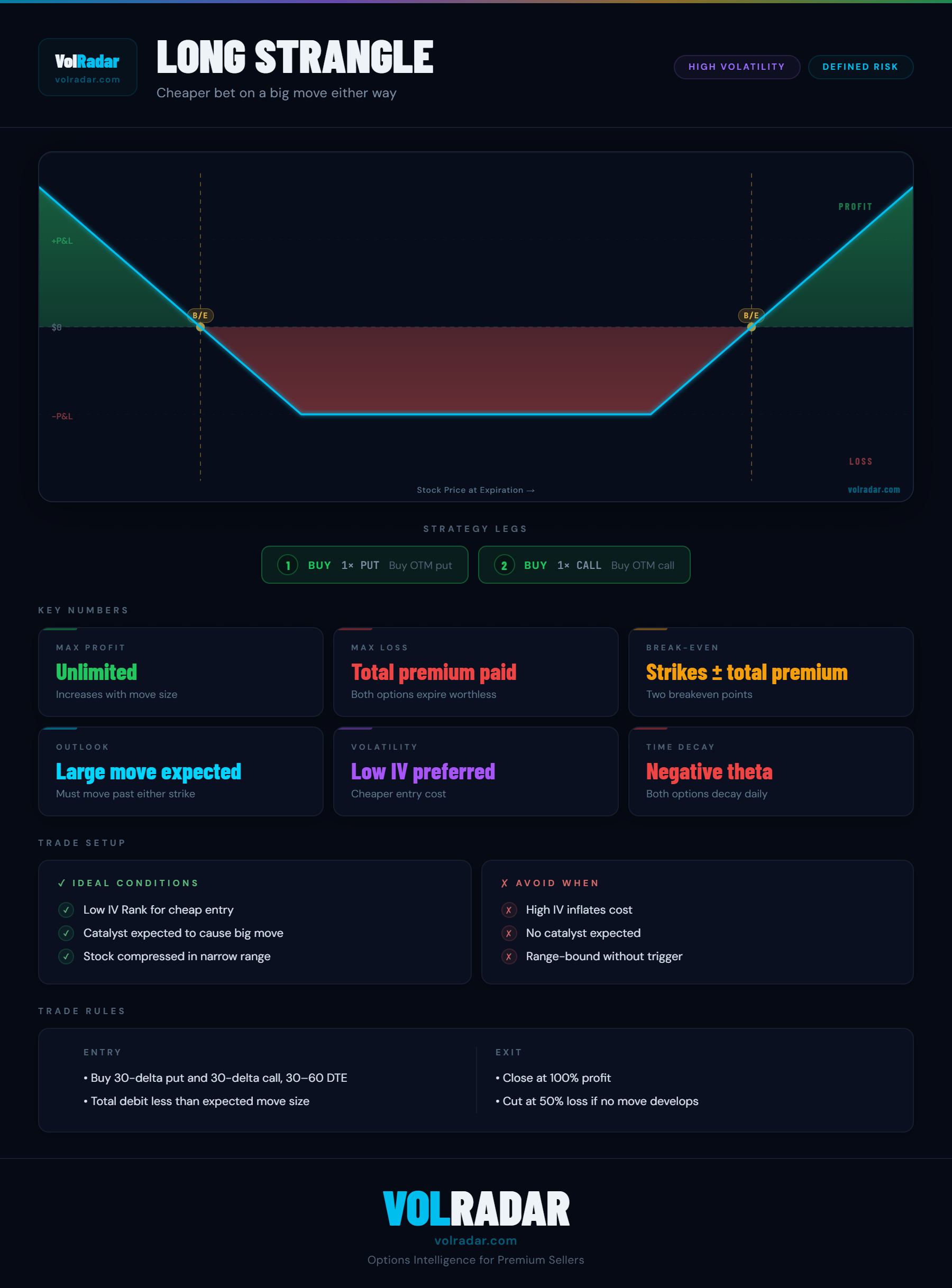
Read the guide→A long strangle buys an out-of-the-money call and an out-of-the-money put at different strikes with the same expiration, with the call strike above the put strike. It costs less than a straddle but generally needs a larger price move to reach break-even, targeting high-volatility scenarios. The maximum loss is the total premium paid.
The position
Direction
Volatility-long
- Drives outcome
- A move beyond either strike larger than the total premium.
- Max profit
- Unlimited on upside; downside limited as price cannot fall below zero.
- Risk type
- Defined (debit paid)
VolRadar Lens
- Cheaper than
- Typically a long straddle at the same expiry
A cheaper volatility bet than a straddle: held to expiration, it needs the stock to move past either strike by more than the total premium paid.
Visual ReferencePayoff structure and strike placementShowHide
Why It Matters
Premium sellers frequently short strangles to collect income from both OTM sides. The long strangle is the mirror trade. Understanding it clarifies what short strangle sellers are risking and when buying volatility makes tactical sense. A long strangle is long gamma and long vega, the opposite of a short strangle's exposure.
How It Works
Select an OTM call and an OTM put with the same expiration. Illustrative numbers: with the underlying at $530, buy the $560 call for $3.20 and the $500 put for $2.90. Total debit: $6.10 per share. Upside breakeven: $566.10. Downside breakeven: $493.90. A move of $36.10, about 6.8% of $530, in either direction is the break-even at expiration; a larger move is needed for a profit. Before expiration, vega matters too: if implied volatility rises before the stock moves, both legs can gain value even without underlying movement. Breakevens sit outside both strikes by the total premium paid. On a $100 stock with a $5 debit strangle at $95/$105, breakevens are $90 and $110, so a profit at expiration requires a move of more than 10% in either direction. The Options Industry Council also lists this strategy as a long combination; a related variation with the call strike below the put strike is called a gut.
Example
Hypothetical example. Before an earnings report, stock XYZ trades at $138. You buy the 130 put at $2.20 and the 146 call at $2.40, a total debit of $4.60 per share, or $4.60 x 100 = $460 (contract multiplier 100 for standard US equity options). Break-evens at expiration: $146 + $4.60 = $150.60 and $130 - $4.60 = $125.40. XYZ reports and rallies to $152 within two sessions; assume the 146 call is then quoted at $7.80 and the 130 put at $0.25, total $8.05. Closing both legs gives ($8.05 - $4.60) x 100 = $345 before fees, 75% of the $460 paid. If XYZ instead finished anywhere between $130 and $146 at expiration, both options would expire worthless and the full $460 would be lost. The option prices after the move are assumed for illustration, not model output.
Common Mistakes
Placing strikes far OTM lowers the cost but requires a larger move before either option has value at expiration. Choosing too short an expiration leaves less time for the anticipated move. Failing to account for a drop in implied volatility after earnings: if the stock's move is not large enough to offset the fall in implied volatility, the strangle can show a loss even after a gap.
Is the market paying premium sellers today?
The SPY Premium Window study tracks when systematic option selling has historically been compensated — recomputed daily from market close. Free to read, no account needed.
Frequently Asked Questions
Why pick a long strangle instead of a long straddle?
Long strangles use OTM strikes on both sides, lowering total premium relative to ATM straddles. The reduced cost comes with wider break-evens: the underlying must travel further to profit, but the maximum loss is smaller. Strangles suit traders expecting a large move with uncertain direction, large enough to carry the stock beyond one of the breakevens (the call strike plus the total premium, or the put strike minus it).
How are long strangle strikes typically chosen?
Strike distance is a trade-off. Strikes closer to the current price cost more but need a smaller move to reach break-even; strikes further out cost less but need a larger move, and are more likely to expire worthless. Comparing the break-evens (call strike + total premium, put strike - total premium) with the move you expect is a direct way to compare choices.
What is the worst-case scenario for a long strangle?
Max loss equals the total premium paid, realized when the underlying expires between the two strikes with both the call and the put worthless. This can happen after a quiet catalyst or an extended consolidation. A long strangle bought for $4.80 has a max loss of $4.80 x 100 = $480 for one call and one put (standard 100 multiplier). Time decay and a fall in implied volatility both push toward this outcome, so entry timing matters alongside strike selection.
How does IV environment affect long strangle entries?
Both legs are long options, so a rise in implied volatility helps and a fall hurts, all else equal. High implied volatility raises the entry cost and exposes the position to a volatility drop if the catalyst delivers a smaller-than-expected move. Lower implied volatility makes the strangle cheaper and leaves room for a volatility increase to add value before the stock moves.
When should you close or roll a long strangle?
Traders can close both legs before expiration, close the winning leg while keeping the other in case of a reversal, or roll strikes; each choice changes the remaining risk. Holding to expiration means the position is worth only its intrinsic value: both legs expire worthless if the stock ends between the strikes, and an in-the-money leg may be exercised automatically, creating a stock position.
General references
General references for this topic area, not citations for the specific figures above. VolRadar is not affiliated with these organizations.
The information about Long Strangle above is for educational purposes only and is not financial advice. Read our full investment disclaimer.
Understand options faster.
One term, one worked example, one real ticker. Every Sunday. No jargon.
One email per week, no drip campaigns · Unsubscribe anytime