Loading...
Strategies
Short Guts — Options Strategy Explained
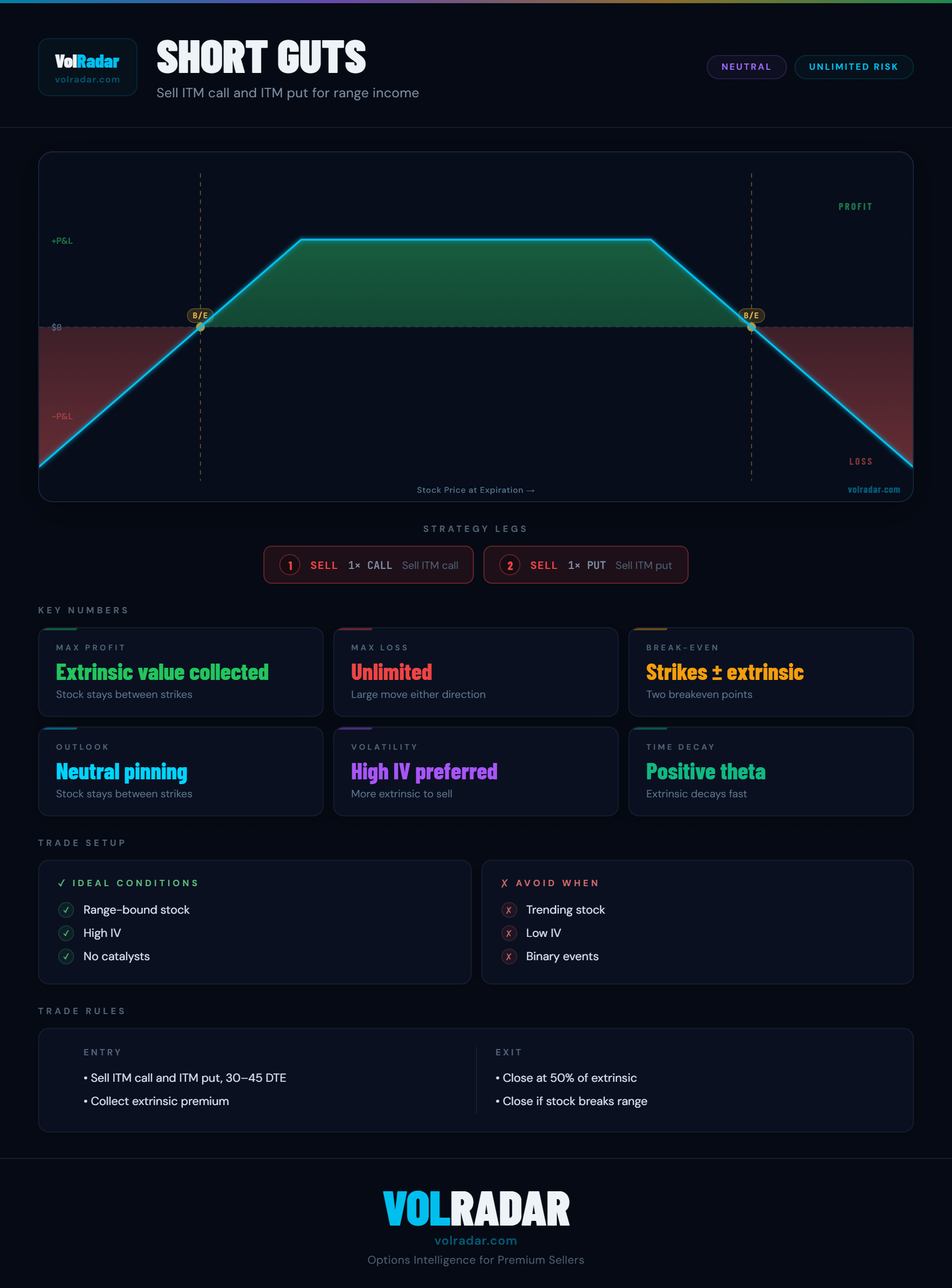
A short guts sells an in-the-money call and an in-the-money put with the same expiration, the call strike below the put strike.
By Aigars PilmanisLast updated
Educational content. Not financial, investment, tax, or legal advice. Options involve risk and are not suitable for all investors. How we write & review this glossary.
Read the full guide
Short Guts — Sell ITM Call and Put for Maximum Premium
A short guts sells an ITM call and an ITM put — collecting the richest premium of any short volatility trade. Why both options are exposed to early assignment, and how short guts compare to short straddles.
Read the guide→A short guts is a short volatility position that sells an in-the-money call and an in-the-money put on the same underlying with the same expiration, so the call strike is below the put strike. It is the in-the-money counterpart of a short strangle: the credit is larger because it includes intrinsic value, but the profit at expiration is still limited to the time value collected.
Video explainer5:20
Watch: Short Guts Explained
5:20 walkthrough — definition, mechanics, worked example, and common mistakes for Short Guts.
What to remember from this video
Short guts strategy is like threading a needle, with maximum profit when the stock price stays between the strikes.
Key Insights From The Video
- Short guts involves selling an ITM call and ITM put at different strikes.
- Collects more premium than a short strangle but with same risk profile.
- Maximum profit occurs when the stock price stays between the strikes.
- Margin requirements and early assignment risk depend on the broker and the ITM options involved.
- Profit comes from extrinsic value decay, not the large upfront credit.
Read the complete video explanation~248 words · 1 min read
The short guts strategy involves selling an in-the-money (ITM) call option and an ITM put option at different strike prices. This setup is known for generating a large upfront credit, which can be enticing at first glance. However, the majority of this credit is intrinsic value, meaning it reflects the current value of the options being in-the-money, rather than potential profit.
To visualize this, imagine a stock trading at $100. You might sell a 95 strike call and a 105 strike put. Both options are $5 in-the-money, creating a bracket around the current stock price. The strategy earns its maximum profit if the stock price remains between these strikes until expiration, allowing you to keep the extrinsic value as the options decay.
Despite the large initial credit, the true profit potential is limited to the decay of extrinsic value, similar to a short strangle. The risk profile is similar, with losses that grow if the stock moves significantly outside the strike range, unbounded on the upside.
The short guts can carry higher margin requirements and comes with a risk of early assignment that varies with extrinsic value, dividends and time remaining, and is notable because the options are ITM from the start. This risk is heightened around ex-dividend dates, necessitating active management.
Ultimately, while the short guts offers a tempting upfront payout, it demands careful oversight and resembles a short strangle at expiration. Traders must weigh the complexity and risks against the potential rewards when considering this strategy.
The position
Structure
A short guts sells an in-the-money call and in-the-money put at different strikes, collecting more premium than a short strangle.
- Direction
- Neutral
- Drives outcome
- Both legs are ITM at entry, and the risk profile stays undefined.
- Risk type
- See structure
VolRadar Lens
Because at least one leg always finishes in the money, a short guts never keeps its whole credit: the most it can keep is the credit minus the distance between the two strikes, which is close to what the matching short strangle collects.
Why It Matters
The large headline credit can make a short guts look more rewarding than a short strangle, but most of it is intrinsic value that has to be paid back at expiration. What the seller can keep is the time value, about the same as on the equivalent strangle, while the in-the-money legs add early-assignment risk.
How It Works
With the call strike Kc below the put strike Kp, at expiration the combined intrinsic value of the two options is at least Kp - Kc: anywhere between the strikes it equals exactly Kp - Kc, and outside them it grows with the stock's distance from the nearer strike. So the maximum profit, reached anywhere between the strikes, is the credit minus (Kp - Kc). The upper break-even is Kc plus the credit; the lower break-even is Kp minus the credit. Above the upper break-even losses grow without limit through the short call; below the lower break-even losses grow until the stock reaches zero. Put-call parity links each in-the-money option to the out-of-the-money option at the same strike, which is why a short guts and a short strangle on the same two strikes have nearly the same profit and loss once the intrinsic value is set aside. Both legs start in the money and are American-style on US equity options, so either can be assigned early.
Example
Hypothetical (Black-Scholes prices, stock $100, 30 days, implied volatility 30%, interest 4%, no dividends, standard US equity options of 100 shares): sell the $95 call at about $6.65 and the $105 put at about $6.32, a credit of $12.97 per share ($1,297). At expiration between $95 and $105 the two options together are worth $10, so the profit is $12.97 - $10 = $2.97 per share ($297). Break-evens: $95 + $12.97 = $107.97 and $105 - $12.97 = $92.03. For comparison, a short strangle selling the $105 call (about $1.66) and the $95 put (about $1.33) collects $2.99, with break-evens of $107.99 and $92.01.
Common Mistakes
Treating the credit as the maximum profit. Labelling a position with two out-of-the-money options as a guts; that is a strangle. Assuming the maximum profit needs the stock to pin at one price: it applies anywhere between the two strikes. Ignoring early assignment on the in-the-money call before an ex-dividend date, or on the in-the-money put.
Is the market paying premium sellers today?
The SPY Premium Window study tracks when systematic option selling has historically been compensated — recomputed daily from market close. Free to read, no account needed.
Frequently Asked Questions
What is the difference between short guts and a short strangle?
A short strangle sells an out-of-the-money call and an out-of-the-money put; a short guts sells in-the-money ones, so the call strike sits below the put strike. The guts collects more premium, but the extra is intrinsic value; with the same two strikes, the profit and loss of the two positions are nearly the same.
What is the maximum profit on a short guts?
The credit received minus the distance between the put strike and the call strike, earned if the stock finishes anywhere between the two strikes at expiration.
General references
General references for this topic area, not citations for the specific figures above. VolRadar is not affiliated with these organizations.
Visual ReferencePayoff structure and strike placementShowHide
The information about Short Guts above is for educational purposes only and is not financial advice. Read our full investment disclaimer.
Understand options faster.
One term, one worked example, one real ticker. Every Sunday. No jargon.
One email per week, no drip campaigns · Unsubscribe anytime