
What is a short guts strategy?
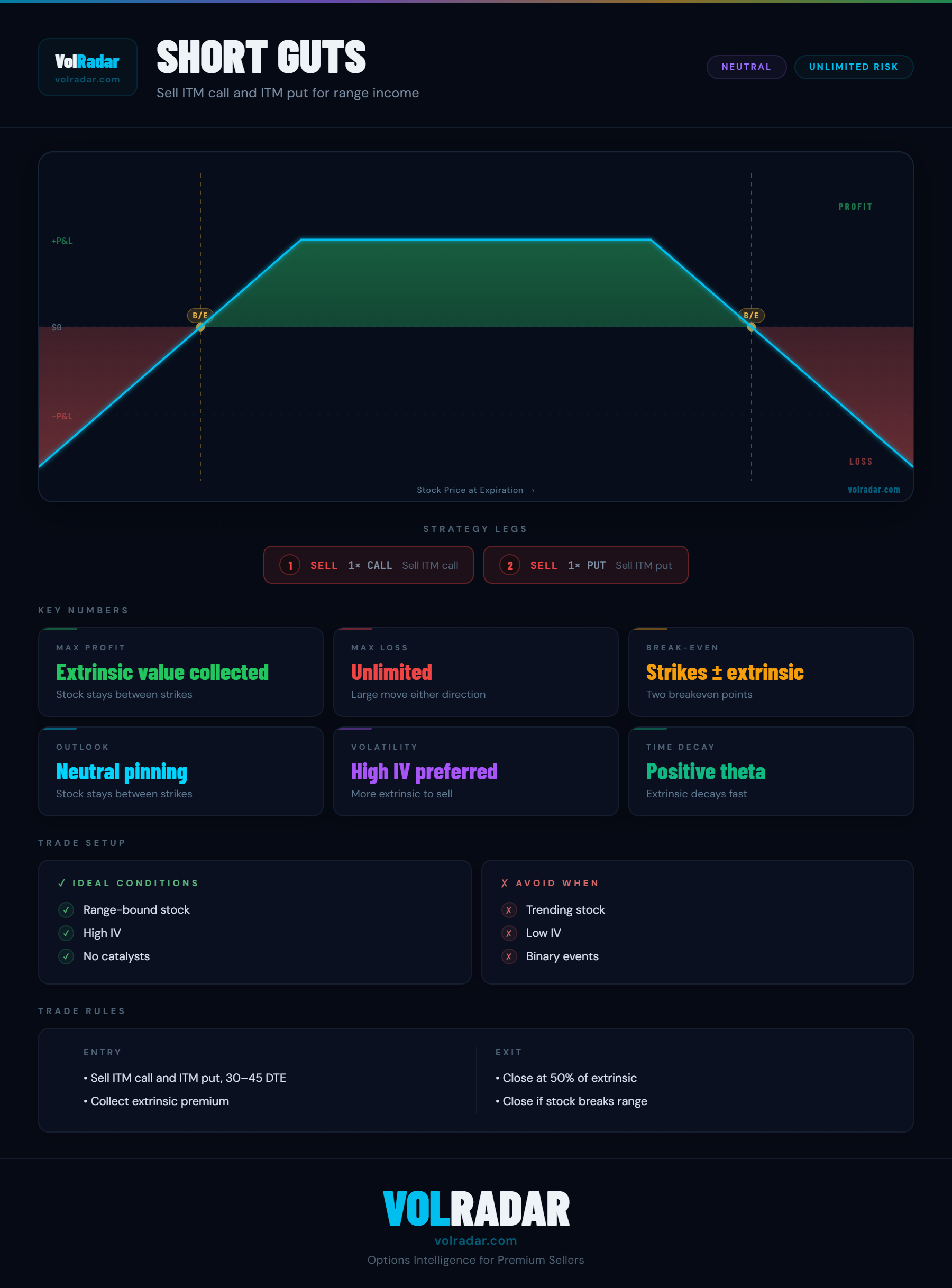
A short guts sells 1 ITM call and 1 ITM put on the same expiration. Because both options are in the money, the premium collected is very high — higher than an ATM short straddle. The position profits if the stock moves enough in either direction for one of the options to have its full intrinsic value offset by the premium. Both options are in the money at entry, creating immediate assignment risk.
Short guts vs short straddle
A short straddle uses ATM options — the premium is the highest available for ATM options but lower than ITM options. A short guts uses ITM options, collecting more total premium but also carrying more intrinsic risk. The short guts has a wider theoretical profit zone due to the ITM strikes, but both options being in the money creates early assignment risk that the short straddle does not have.
Assignment risk
When you sell an ITM option, it can be exercised at any time (American-style options). Selling both an ITM call and ITM put means both can be assigned early — potentially leaving you simultaneously long and short 100 shares. Monitor the position constantly and be prepared to close one or both legs at any time. This strategy should only be used by experienced traders with full understanding of assignment mechanics.
Practical considerations
Short guts are rarely used in retail trading due to the assignment complexity and high margin requirements. Institutional traders may use them as part of delta-neutral volatility selling books. For most practical premium selling goals, the short straddle or iron butterfly provides similar income potential with much more manageable risk and no early assignment risk on both legs simultaneously.