
What is a guts options strategy?
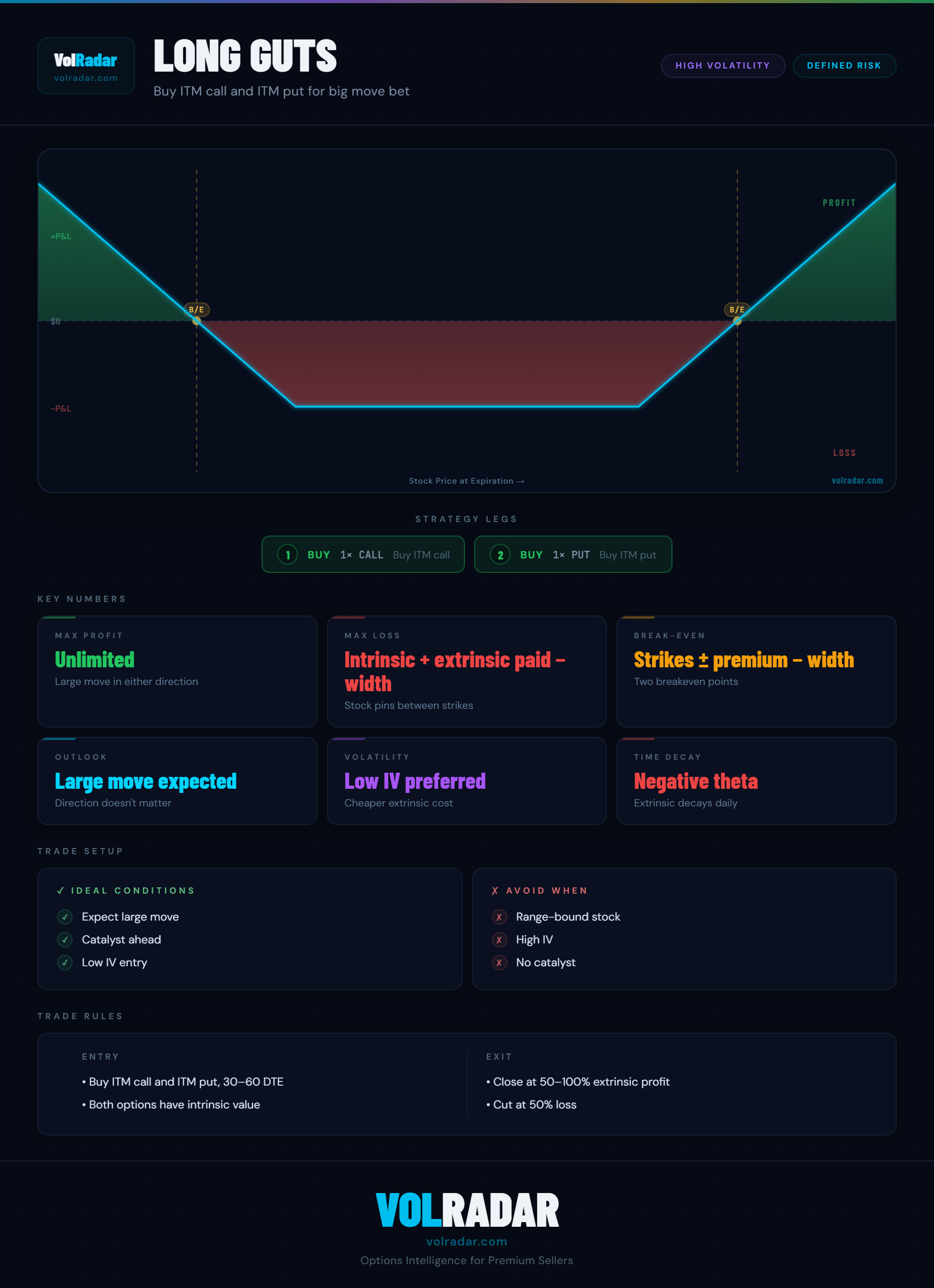
A long guts combines buying an in-the-money call and an in-the-money put at the same expiration. The ITM options carry both intrinsic and extrinsic value. The strategy profits from a large move in either direction — similar to a straddle, but using ITM strikes instead of ATM strikes. Because ITM options have more intrinsic value, the guts costs more than a straddle but decays more slowly on an absolute basis.
Guts vs long straddle
A long straddle uses ATM options (maximum extrinsic value, maximum theta decay). A long guts uses ITM options (more intrinsic, less extrinsic, slower theta decay). The guts costs more upfront due to the intrinsic value, but the intrinsic portion does not decay. For the same dollar investment, a straddle offers higher leverage; for the same notional exposure, a guts position is more stable over time.
Short guts
A short guts sells an ITM call and ITM put — the inverse. It collects more premium than a short straddle (because ITM options are worth more) but requires the stock to move significantly to be profitable at expiration. The position must be closed before expiration if the stock moves, as both options will be assigned if left to expiry. Short guts have complex margin and assignment requirements.
When to use a guts strategy
Guts are rarely used by retail traders due to their high cost and complexity. They appear in institutional hedging when specific delta and intrinsic value targets are needed. For most practical purposes, a long straddle achieves the same goal (profit from large moves) at lower cost and simpler structure. Consider a guts only if you specifically need the higher intrinsic value component for hedging purposes.