
What is a long call butterfly?
A long call butterfly uses three strikes: buy 1 call at a lower strike, sell 2 calls at a middle strike, and buy 1 call at a higher strike. The strikes are typically equidistant. The net debit is small. Maximum profit is achieved if the stock pins exactly at the middle (short) strike at expiration. The position profits in a narrow range around the middle strike and has fully defined risk (the net debit paid).
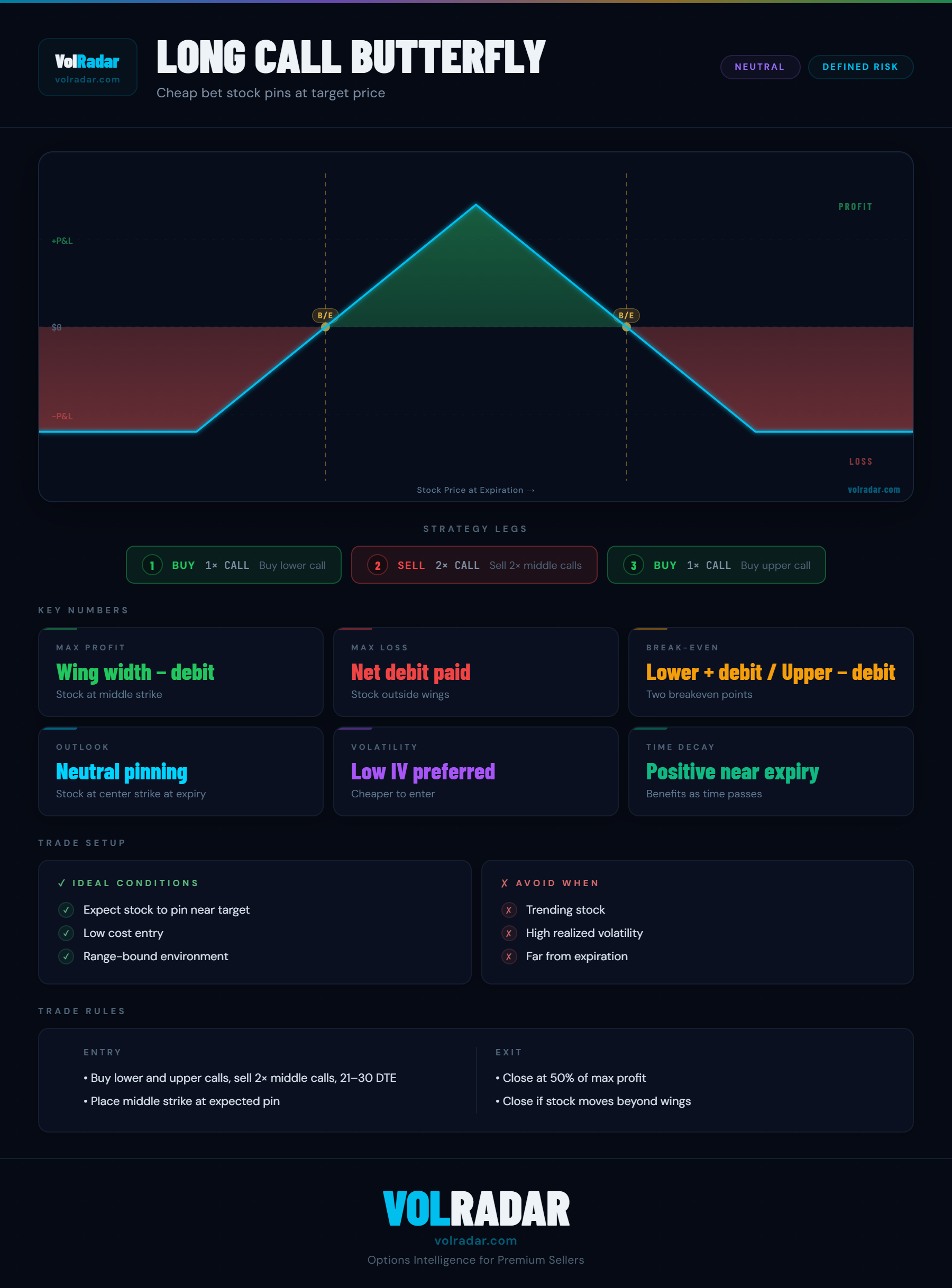
Long call butterfly setup
Choose strikes evenly spaced around the target price (e.g., $95/$100/$105 for a $100 stock). Buy 1 call at the lower strike ($95), sell 2 calls at the middle strike ($100), buy 1 call at the upper strike ($105). The net debit is the max loss. Max profit equals the wing width ($5) minus the net debit. Breakevens are lower strike plus net debit and upper strike minus net debit.
When to use a long call butterfly
Long call butterflies are most effective when IV is elevated (making the sold short strikes rich) and you expect the stock to stay near a specific price — for example, near a key support or resistance level after a volatile period. They can also be used as a low-cost way to profit from a stock pinning near a round number near expiration (retail option expiration pinning effect). The low debit makes the risk-to-reward attractive.
Risk, reward, and limitations
Max loss is the net debit paid (small). Max profit is the wing width minus the debit. The position is sensitive to the stock being at the exact middle strike at expiration — any significant move reduces profits. Butterflies are not ideal for volatile markets or trending stocks. They have low probability of maximum profit but an attractive risk-to-reward ratio (often 5:1 or higher) if the stock cooperates.