
What is a short call butterfly?
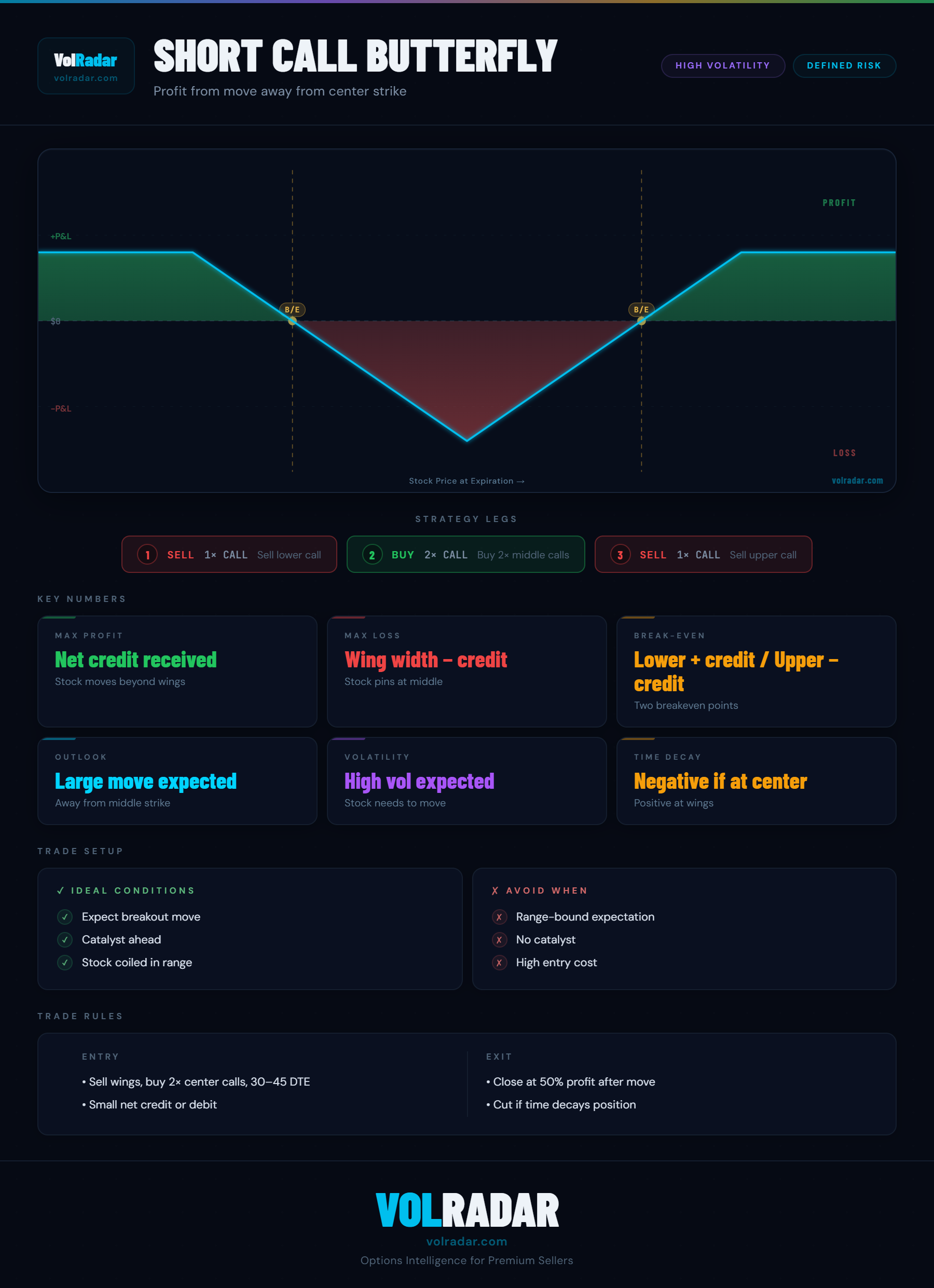
A short call butterfly reverses the wing structure of a long butterfly: sell the outer calls and buy the inner two. You collect a small net credit. The position profits if the stock moves significantly above the upper strike or below the lower strike. Between the two outer strikes, the position loses — maximum loss equals the wing width minus the credit received. It is a defined-risk way to position for a large move.
Short butterfly vs long straddle
Both strategies profit from large moves. A long straddle costs more (larger debit) but has higher profit potential on big moves. A short butterfly collects a credit (or pays a tiny debit) and has defined risk, but the profit is capped at the wing spread. If you expect a large but uncertain direction move and want defined risk, the short butterfly is a cost-efficient alternative to the straddle.
When to use a short call butterfly
Use a short butterfly before events where a large move is expected — earnings, FOMC, regulatory announcements — when the structure is cheap or at a credit. The key criterion is that IV must be low (making the butterfly cheap) and the stock must actually move significantly. Avoid short butterflies when IV is already elevated — the premiums will make the structure expensive.
Risk and reward
Max profit is realized if the stock moves beyond either outer wing strike. Max loss is the wing width minus the credit (small). This favorable risk-to-reward ratio (limited downside, meaningful upside) makes the short butterfly attractive as a low-cost volatility play. The challenge is that it requires a specific magnitude of move — neither too small (the stock stays near center) nor beyond a strike (though beyond the outer wing is best).