
What is a put broken wing butterfly?
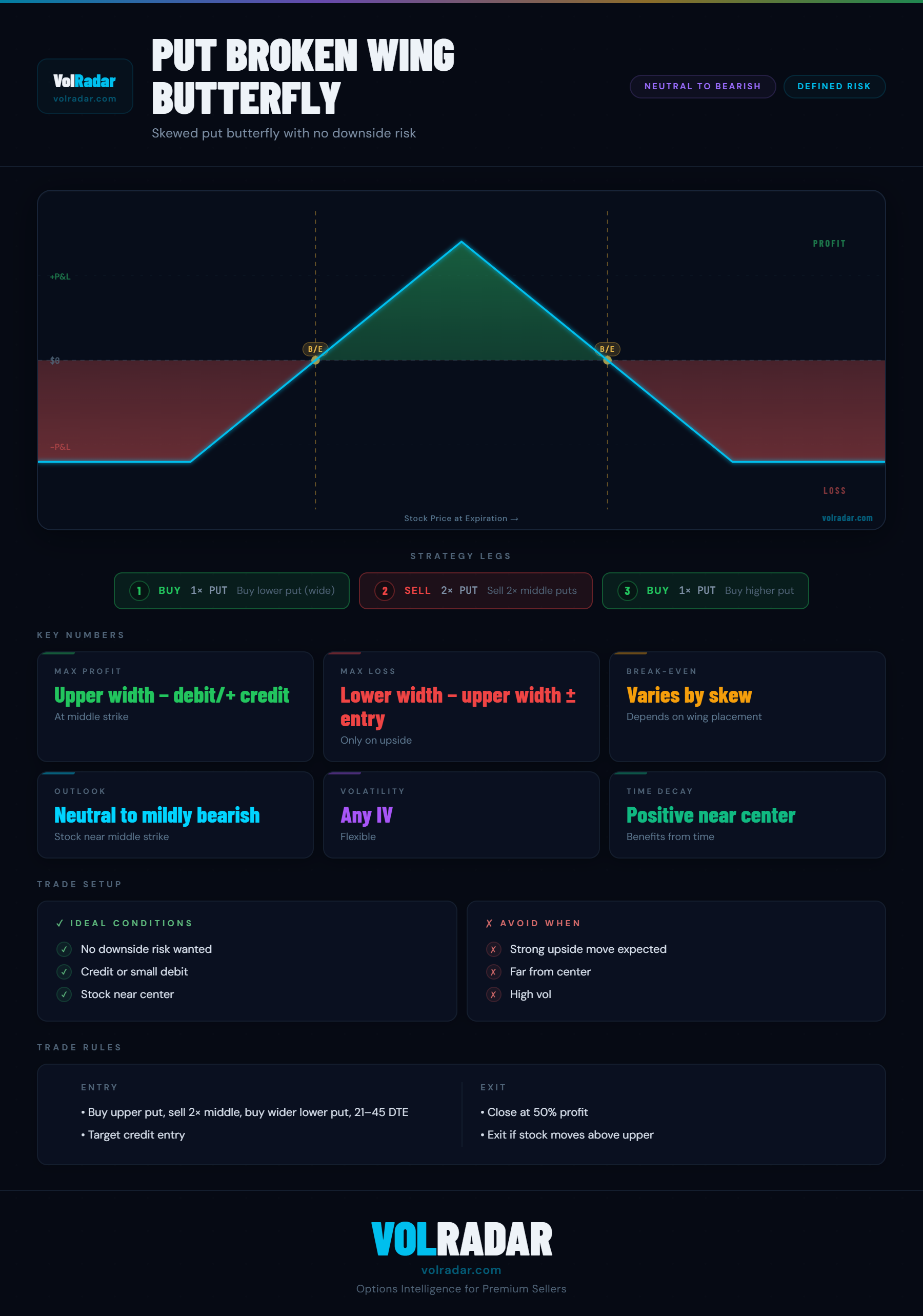
A put broken wing butterfly sells 2 puts at the middle strike, buys 1 put at the upper strike (closer to the money), and buys 1 put at a wider lower strike than the standard mirror distance. Example: buy the $105 put, sell 2 $100 puts, buy the $90 put (instead of $95). The wider lower wing costs less to buy, turning the structure into a credit. If entered at a credit, the stock can fall to the lower wing before any loss occurs.
Why the put broken wing is popular
The put broken wing is favored by premium sellers because it addresses a common frustration with cash-secured puts: the stock occasionally drops sharply, creating a large unrealized loss. The broken wing structure collects premium upfront and has no upside risk — unlike a cash-secured put, the stock can rally freely. The downside risk is concentrated but defined at the lower wing. It is often described as a "better cash-secured put" for experienced traders.
Setup and verification
Choose strikes such that the total credit collected exceeds zero — a net credit trade. Buy the upper put near 30–40 delta, sell the two middle puts near 15–20 delta, buy the lower put 5–10 strikes further down than the symmetric distance. Model the exact strikes in a calculator to confirm: 1) net credit, 2) no upside loss, 3) the maximum loss level on the downside is at an acceptable level.
Risk and management
If entered at a credit: no loss above the upper long put strike. Max loss is at the lower (wider) wing — typically a large drop below the middle strikes. Manage at 50% of max profit and close if the stock approaches the lower wing. The put broken wing is significantly more complex than a standard bull put spread and should only be used after modeling the full P&L profile in advance.