
What is a short put butterfly?
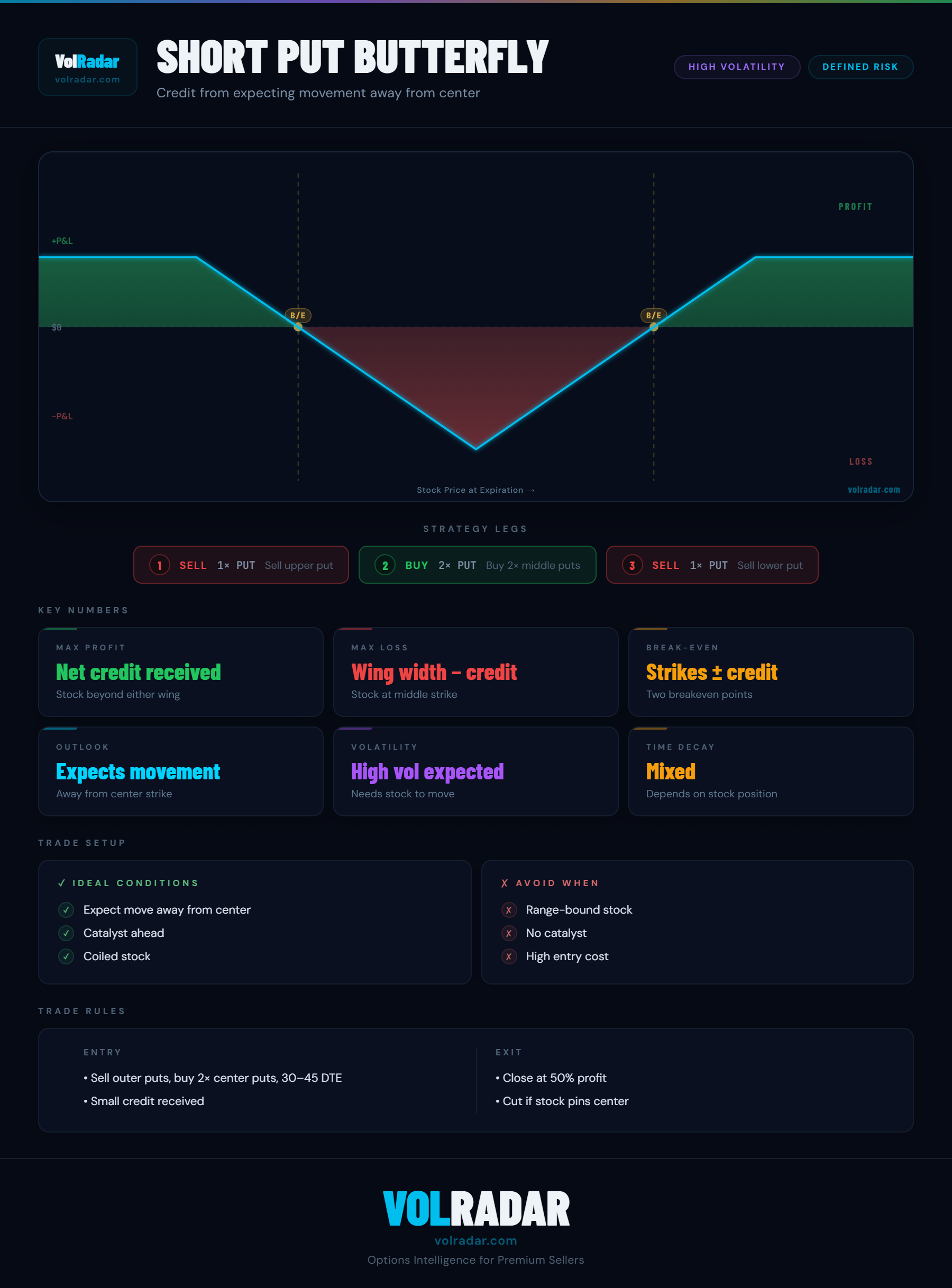
A short put butterfly mirrors the short call butterfly structure using put options: sell 1 put at the upper strike, buy 2 puts at the middle strike, sell 1 put at the lower strike. You collect a small credit. The position profits when the stock moves significantly from the middle strike in either direction. Loss is limited to the spread between wings minus the credit received.
Choosing between short call and short put butterflies
Due to put-call parity, short call and short put butterflies at the same strikes have theoretically identical payoffs. In practice, pricing differences from skew can make one more favorable than the other. When put skew is steep (puts are expensive), the short put butterfly collects more credit. When call skew is elevated, the short call butterfly is cheaper. Always compare both to find the more efficient structure.
When to use a short put butterfly
Short put butterflies are most useful before events likely to cause a large move (earnings, macro data) when IV is moderate and the butterfly can be entered at a credit or minimal debit. They are also used by traders who expect a sharp downside move specifically — centering the butterfly below the current price increases the probability of profiting from a downward move.
Risk and reward
Max loss is the wing width minus the credit, achieved if the stock stays near the middle strike. Max gain is the credit collected plus any intrinsic value gain if the stock moves beyond an outer wing. Like all short butterflies, the risk is a low-probability but high-frequency event: the stock not moving enough. Use position sizing appropriate to the max loss, not the small credit received.