Loading...
Strategies
Jade Lizard — Options Strategy Explained
A jade lizard sells an out-of-the-money put and an out-of-the-money call spread on the same stock and expiration.
By Aigars PilmanisLast updated
Educational content. Not financial, investment, tax, or legal advice. Options involve risk and are not suitable for all investors. How we write & review this glossary.
Jade Lizard vs Short Strangle vs Iron Condor
Jade Lizard sells a put and a call credit spread above price, sized so the total credit exceeds the call spread width and eliminates upside risk. Short Strangle sells a naked call and a naked put, with unlimited call-side risk. Iron Condor defines risk on both sides with long protective wings.
| Feature | Jade Lizard | Short Strangle | Iron Condor |
|---|---|---|---|
| Upside risk | Eliminated when credit exceeds call spread width | Undefined on the call side | Defined by the long call wing |
| Downside risk | Open below the short put strike | Open below the short put strike | Defined by the long put wing |
| Credit received | Moderate, sized to neutralize upside | Highest because both legs are naked | Lowest because both wings are paid for |
| Number of legs | Three legs total | Two legs total | Four legs total |
| Margin treatment | Margin reflects defined call side and open put side | Margin reflects naked call and put exposure | Margin reflects defined risk on both sides |
| Used to express | A neutral-to-bullish view, with no upside loss when the credit exceeds the call spread width | A neutral range with a naked call and a naked put | A neutral range with defined risk on both sides |
Key trade-off
A jade lizard sells a put and a call spread; when the total credit exceeds the call spread's width there is no loss above the short call, while the put side stays open. A short strangle leaves both sides open for the largest credit. An iron condor caps both sides with long wings.
Read the full guide
Jade Lizard — Sell a Strangle with No Upside Risk
A jade lizard sells an OTM put plus a short call spread — credit collected, zero upside risk if total credit beats the call spread width. Setup math, why it is popular with premium sellers, and how to size.
Read the guide→A jade lizard is a three-leg options strategy that sells an out-of-the-money put and sells an out-of-the-money call spread on the same stock and expiration. If the total credit is at least the width of the call spread, the position cannot lose money above the call strikes at expiration; its risk sits on the downside, like a short put. Before expiration the call spread can still show a mark-to-market loss, and the short call can be assigned early.
The position
Direction
Neutral to bullish
- Drives outcome
- Price staying above the short put; no upside loss when the credit exceeds the call spread width.
VolRadar Lens
- Components
- Short put + short call spread
- Upside risk
- None if credit > call spread width
- Downside risk
- Naked put exposure
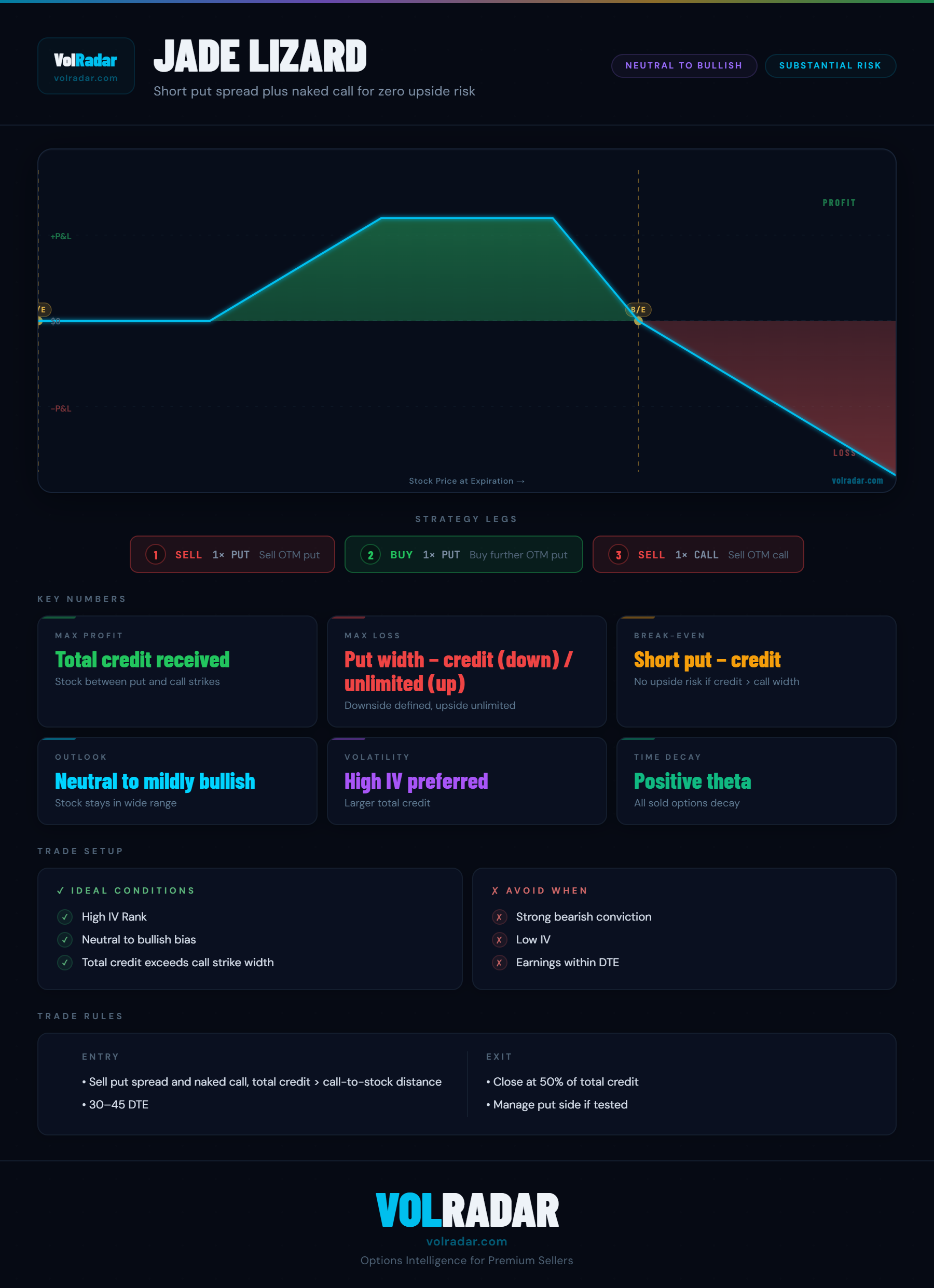
A jade lizard is used with a neutral-to-bullish view. When the total credit is at least the call-spread width, there is no loss above the call strikes at expiration; the real exposure is the short put, with a maximum loss of (put strike - total credit) x 100 if the stock goes to zero.
Visual ReferencePayoff structure and strike placementShowHide
Why It Matters
The jade lizard answers a common premium-seller question: how to collect premium on both sides of the price without the unlimited upside risk of a short strangle. Pairing a short put with a call credit spread does that at expiration, provided the combined credit covers the call-spread width. Higher implied volatility usually raises the credit, because the two short options typically carry more vega than the one long call further out of the money, though the net effect depends on the strikes, skew and time to expiration and can occasionally run the other way; a larger credit makes that condition easier to reach. The trade-off is that, at expiration, the meaningful risk sits on the put side, which has the same price risk as a short put; before expiration the call spread can still show a mark-to-market loss.
How It Works
Three legs, same stock, same expiration: sell an out-of-the-money put, sell an out-of-the-money call, and buy a further out-of-the-money call. The put sits below the stock price and the call spread above it. The key condition is that the total credit is at least the call-spread width. Hypothetical: a $5-wide call spread collects $2.20 and the put collects $3.50, for a total credit of $5.70; since $5.70 is more than $5.00, the worst case above the call strikes at expiration is $5.70 - $5.00 = +$0.70 per share. Maximum profit is the total credit, earned when the stock finishes between the short put and the short call. Downside breakeven is the put strike minus the total credit.
Example
Hypothetical, stock at $100, same expiration: sell the $95 put for $2.50, sell the $105 call for $1.50, buy the $107 call for $0.90. Total credit = $2.50 + $1.50 - $0.90 = $3.10 ($310). The call-spread width is $2, less than the $3.10 credit. At expiration: between $95 and $105, keep +$310 (maximum profit). Above $107, the call spread loses $200 and the result is -$200 + $310 = +$110. Downside breakeven = $95 - $3.10 = $91.90. If the stock went to zero, the loss would be ($95 - $3.10) x 100 = $9,190.
Common Mistakes
Not checking that the total credit covers the call-spread width. Hypothetical: a $4.80 credit on a $5-wide call spread leaves $0.20 per share ($20 per contract) of upside risk at expiration. Treating the upside as having no risk before expiration: the call spread can show a mark-to-market loss, and the short call can be assigned early. Underestimating the put side: the short put has the same price risk as any short put, and it is secured by margin unless it is fully cash-secured. Trading illiquid options: with three legs, wide bid-ask spreads can make a fair net price harder to get, and slippage can take a meaningful share of the credit.
Comparison
Jade lizard vs short strangle vs reverse jade lizard. Short strangle: short put + short call; upside risk unlimited at expiration; downside risk large, to a price of zero; no credit-vs-width condition. Jade lizard: short put + short call spread; no upside loss at expiration if total credit is at least the call-spread width; downside risk as a short put. Reverse jade lizard: short call + short put spread; no downside loss at expiration if total credit is at least the put-spread width; upside risk unlimited, as a short call.
Is the market paying premium sellers today?
The SPY Premium Window study tracks when systematic option selling has historically been compensated — recomputed daily from market close. Free to read, no account needed.
Frequently Asked Questions
How is a jade lizard structured across its three legs?
A jade lizard sells an out-of-the-money put, sells an out-of-the-money call, and buys a further out-of-the-money call, all on the same stock and expiration. The total credit is set to be at least the width of the call spread, which removes loss above the call strikes at expiration. The remaining risk is on the downside, through the short put.
Why is there no upside loss in a jade lizard at expiration?
If the stock finishes above both call strikes, the call spread loses its full width. When the total credit from all three legs is at least that width, the credit already received covers the loss, so the result above the long call at expiration is zero or a profit equal to the total credit minus the call-spread width.
Does a jade lizard have any upside risk?
At expiration, none when the total credit is at least the call-spread width; if the credit is smaller than the width, the difference is an upside loss. Before expiration, a sharp rally can show a mark-to-market loss on the call spread, and the short call can be assigned early because US equity options are American-style.
What is the maximum risk on a jade lizard?
The maximum loss, if the stock goes to zero, is the short put strike minus the total credit, times 100. Hypothetical: a $95 short put with a $4 total credit gives ($95 - $4) x 100 = $9,100 per contract. Below the short put, the trade behaves like a short put alone.
How does a jade lizard compare with a short strangle?
Both sell a put and a call. A short strangle leaves the short call uncovered, so its upside risk is unlimited. A jade lizard buys a further out-of-the-money call, which caps the upside loss and, when the credit covers the call-spread width, removes it at expiration. The long call costs premium, so a jade lizard usually collects less than the equivalent strangle.
General references
General references for this topic area, not citations for the specific figures above. VolRadar is not affiliated with these organizations.
The information about Jade Lizard above is for educational purposes only and is not financial advice. Read our full investment disclaimer.
Understand options faster.
One term, one worked example, one real ticker. Every Sunday. No jargon.
One email per week, no drip campaigns · Unsubscribe anytime