Loading...
Strategies
Long Guts — Options Strategy Explained
Long guts buys an in-the-money call and an in-the-money put with the same expiration, betting on a large move in either direction.
By Aigars PilmanisLast updated
Educational content. Not financial, investment, tax, or legal advice. Options involve risk and are not suitable for all investors. How we write & review this glossary.
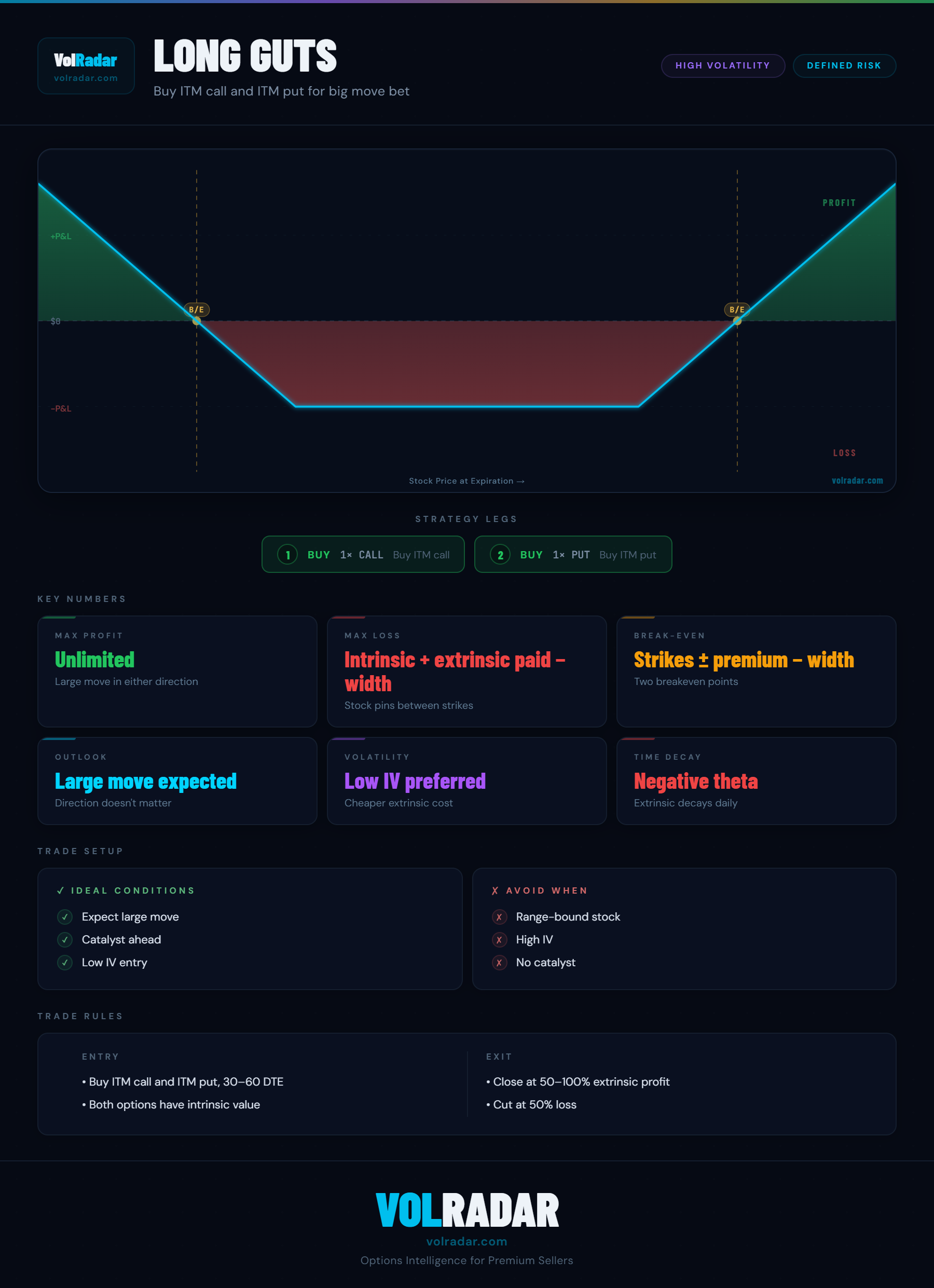
Long guts is an options strategy that buys an in-the-money call and an in-the-money put with the same expiration: the call strike is below the stock price and the put strike is above it. It profits from a large move in either direction. Because at least one leg always finishes in the money, the position is worth at least the gap between the strikes at expiration, so the maximum loss is the debit minus that gap.
Video explainer7:11
Watch: Long Guts Explained
7:11 walkthrough — definition, mechanics, worked example, and common mistakes for Long Guts.
What to remember from this video
The long guts strategy is an in-the-money strangle designed to capture volatility using options with high intrinsic value.
Key Insights From The Video
- Long guts use ITM call and put options.
- Theta decay affects only the extrinsic value, not intrinsic value.
- Example: On a $100 stock, buy a $95 call and $105 put.
- The minimum value at expiration equals the strike gap.
- Capital intensity is high due to upfront intrinsic value costs.
Read the complete video explanation~267 words · 1 min read
The long guts strategy is an in-the-money strangle; because the options carry intrinsic value, only their extrinsic value is subject to time decay, though that extrinsic portion can still be lost in full. This setup involves buying a long call and a long put, both in the money, to capture market volatility with options that have high intrinsic value.
In a typical scenario, traders anticipate a large move in a stock but are unsure of the direction. The long guts strategy positions them to benefit from such a move while holding ITM options; theta decay affects only extrinsic value.
To construct a long guts, consider a stock trading at $100. Buy a call with a strike price of $95 and a put with a strike price of $105. This creates a 10-point spread, with the total debit reflecting this spread plus any extrinsic value.
At expiration, at least one of the options is in the money, so the position's minimum value at expiration equals the strike gap, before the debit paid and costs. A symmetric guts position can start near delta-neutral and commonly has less gamma than an at-the-money straddle, so it typically reacts less to small moves.
The long guts strategy requires significant capital due to the intrinsic value of the options. The upfront cost is higher than for a traditional long strangle, although the risk beyond the strikes remains comparable.
Exit timing depends on settlement and exercise terms, liquidity and the trader's objective; holding to expiration is not inherently improper.
Overall, the long guts strategy is a more capital-intensive way to take a volatility position.
The position
Structure
A long guts combines a long in-the-money call and long in-the-money put at different strikes, similar to a long strangle but with ITM options.
- Direction
- Volatility play
- Drives outcome
- Both legs start in the money, so more of the premium is intrinsic value than in a strangle.
- Risk type
- See structure
VolRadar Lens
Long guts has the same shape of payoff as a long strangle on the same two strikes: at expiration it is worth exactly the strike gap more, and it costs roughly that much more up front (for European options, the present value of the gap). The real risk is the time value paid (debit minus strike gap), lost if the stock ends between the strikes.
Why It Matters
Long guts is a way to buy a large move without choosing a direction, like a straddle or a strangle. Knowing that its profit and loss closely match a strangle on the same strikes stops a common misreading: the higher debit does not mean higher risk, and the in-the-money legs alone do not make a much smaller move enough. For European options the guts' breakevens are closer than the strangle's by the strike gap minus its present value, small for short-dated options at low rates but larger for long-dated options or high rates, while the extra cash tied up forgoes about that much interest. The practical differences are capital (the guts costs roughly the strike gap more) and execution (in-the-money options can have wider bid-ask spreads, so compare quotes before choosing one form over the other).
How It Works
Buy a call with a strike below the stock price and a put with a strike above it, same expiration. Both options are in the money, so the debit includes intrinsic value on both legs plus their time value. At expiration the value is (stock - call strike) + (put strike - stock) when the stock is between the strikes, which always equals the strike gap. Outside the strikes one leg is worth more than the gap and the other is worth nothing. So: maximum loss = debit - strike gap, reached anywhere between the strikes. Lower breakeven = put strike - debit. Upper breakeven = call strike + debit. Gains grow as the stock moves further past either breakeven. At expiration, a long guts on two strikes is worth exactly the strike gap more than a long strangle on the same two strikes (call at the higher strike, put at the lower one). By put-call parity, with European options the guts should cost the present value of that gap more today, so the two positions have close but not identical profit and loss; interest, early-exercise value on American options and bid-ask spreads account for the differences, and the guts ties up more cash. All else equal, both legs generally lose time value as expiration approaches and gain from a rise in implied volatility.
Example
Hypothetical, illustrative prices. A stock trades at $100. Buy the $95 call for $7.00 and the $105 put for $7.20. Debit = $14.20 ($1,420). Strike gap = $105 - $95 = $10. Maximum loss = $14.20 - $10 = $4.20 ($420), anywhere between $95 and $105 at expiration. That $4.20 is exactly the time value paid: $2.00 on the call ($7.00 - $5 intrinsic) plus $2.20 on the put ($7.20 - $5 intrinsic). Breakevens: $105 - $14.20 = $90.80 and $95 + $14.20 = $109.20. If the stock closes at $115, the call is worth $20, the put $0, and the profit is ($20 - $14.20) x 100 = $580.
Common Mistakes
Treating the whole debit as the risk: the maximum loss is the debit minus the strike gap. Thinking the in-the-money legs need a much smaller move to profit: on the same strikes the breakevens are close to a strangle's; for European options they are nearer only by the strike gap minus its present value. Ignoring time value: between the strikes, the entire time value paid is lost at expiration. Ignoring implied volatility: buying after implied volatility has already risen, for example just before a known event, means a fall in implied volatility after the event can offset part of the move.
Comparison
Long guts vs long strangle: a strangle buys an out-of-the-money call and put; the guts buys in-the-money ones. On the same two strikes their profit and loss are close, but the guts costs roughly the strike gap more up front (its present value for European options) and is worth exactly the gap more at expiration. Long guts vs long straddle: a straddle buys a call and a put at one strike, usually at the money; its maximum loss is the whole debit, reached only if the stock ends exactly at the strike.
Is the market paying premium sellers today?
The SPY Premium Window study tracks when systematic option selling has historically been compensated — recomputed daily from market close. Free to read, no account needed.
Frequently Asked Questions
What is a long guts options strategy?
It is a long-volatility strategy that buys an in-the-money call (strike below the stock price) and an in-the-money put (strike above it) with the same expiration. It profits if the stock moves far enough in either direction.
What is the maximum loss on long guts?
The debit paid minus the gap between the two strikes, which equals the time value paid. It is reached if the stock is anywhere between the strikes at expiration. In the example, $14.20 - $10 = $4.20, or $420 per position.
Where are the breakevens for long guts?
Lower breakeven = put strike - debit. Upper breakeven = call strike + debit. For a $95 call and $105 put bought for $14.20, they are $90.80 and $109.20.
How is long guts different from a long strangle?
A strangle uses out-of-the-money options and a guts uses in-the-money ones. On the same two strikes the profit and loss are close but not identical: the guts is worth exactly the strike gap more at expiration and costs roughly that much more up front (for European options, the present value of the gap; interest, early exercise of American options and bid-ask spreads create differences that can be material for a wide strike gap, a long time to expiration or a high interest rate).
How do time decay and implied volatility affect long guts?
Both legs are long options, so, all else equal, the position generally loses time value as expiration approaches and gains when implied volatility rises. Only the time value decays; the intrinsic value on the two in-the-money legs does not.
General references
General references for this topic area, not citations for the specific figures above. VolRadar is not affiliated with these organizations.
Visual ReferencePayoff structure and strike placementShowHide
The information about Long Guts above is for educational purposes only and is not financial advice. Read our full investment disclaimer.
Understand options faster.
One term, one worked example, one real ticker. Every Sunday. No jargon.
One email per week, no drip campaigns · Unsubscribe anytime