Loading...
Strategies
Short Put Condor — Options Strategy Explained
A short put condor sells the lowest and highest strike puts and buys the two middle strike puts, receiving a net credit.
By Aigars PilmanisLast updated
Educational content. Not financial, investment, tax, or legal advice. Options involve risk and are not suitable for all investors. How we write & review this glossary.
Read the full guide
Short Put Condor — Defined-Risk Bet on a Large Move Using Puts
A short put condor sells the outer puts and buys two inner puts — credit collected, payoff on a sharp move either way. How it mirrors the call version and when put skew favours the put variant.
Read the guide→A short put condor is a four-leg position built only from puts with the same expiration: it sells the puts at the lowest and highest strikes and buys the puts at the two strikes between them, for a net credit. It is the opposite of the long put condor described by the Options Industry Council (OIC). With equal wing widths, its gain is capped at the credit, which it keeps if the underlying finishes at or beyond the outer strikes, and its loss is capped at the wing width minus the credit.
The position
Structure
A short put condor sells one higher-strike put, buys two middle-strike puts, and sells one lower-strike put.
- Direction
- Non-directional; benefits from a large move.
- Drives outcome
- Same payoff as a short call condor, built with puts.
- Risk type
- See structure
VolRadar Lens
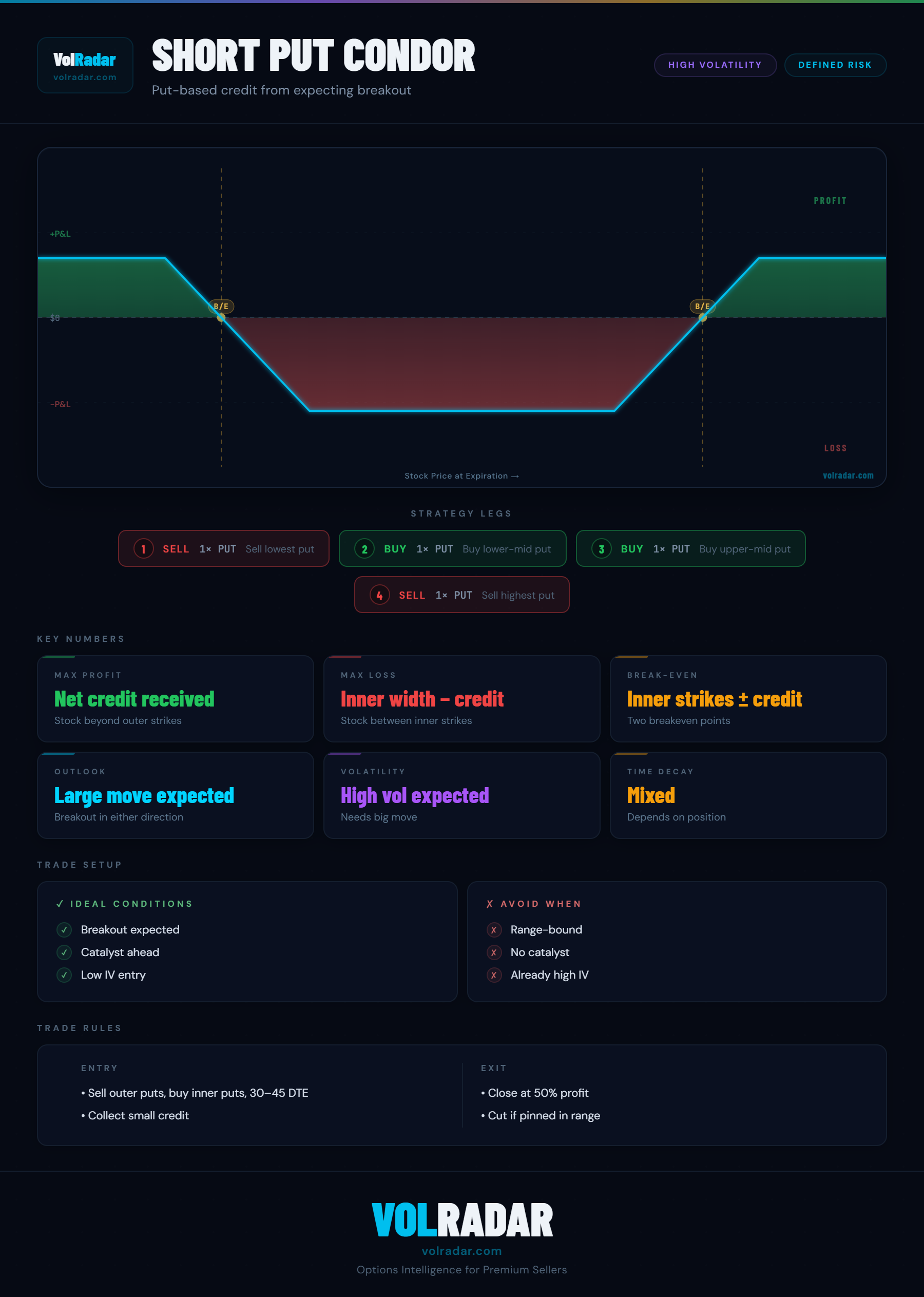
With equal wing widths, both outcomes are capped: the gain is the credit and the loss is the wing width minus the credit. It pays off from a finish outside the outer strikes, unlike the standard iron condor, which gains inside a range.
Visual ReferencePayoff structure and strike placementShowHide
Why It Matters
The short put condor is a defined-risk position that pays its maximum when the underlying finishes outside the outer strikes and loses most when it finishes between the middle strikes, using only puts. Because a call-based or reverse iron condor version has the same payoff shape, the choice between them is about the prices, spreads and account treatment of the options involved, not about a different bet. Its capped gain means the credit is the most it can earn, however far the underlying moves.
How It Works
Take four put strikes K1 < K2 < K3 < K4 with the same expiration and equal wing widths (K2 minus K1 equals K4 minus K3). Sell the K1 put, buy the K2 put, buy the K3 put and sell the K4 put. OIC's long put condor is the same four legs with every buy and sell reversed, and OIC says its maximum loss is the net debit when the distances between the four strikes are equal. Reversing the sides gives the short version. At expiration, per share: if the underlying finishes at or below K1, or at or above K4, the result is the credit, which is the maximum gain. If it finishes between K2 and K3, the result is the credit minus the wing width (K2 minus K1, equal to K4 minus K3), which is the maximum loss. Between a long strike and its short strike the result changes in a straight line. The breakevens are K1 plus the credit and K4 minus the credit. OIC notes for the long put condor that the effect of implied volatility changes depends on strike selection relative to the stock price, and that four contracts may mean four separate commission charges; the same caveats apply here. Naming differs between sources: OIC's long condor and what this glossary calls a reverse iron condor profit from a large move, as this position does, while OIC's short condor (iron condor) profits inside a range. With equal wing widths, an all-put short condor and a reverse iron condor on the same four strikes have the same payoff shape; the premiums differ by a constant that put-call parity ties to the strike width, in a frictionless European-style market.
Example
Hypothetical, per share, with standard US equity options (100 shares per contract). XYZ trades at $420. Sell the 410 put at $3.20, buy the 415 put at $4.80, buy the 425 put at $9.20 and sell the 430 put at $11.40. Net credit = 3.20 minus 4.80 minus 9.20 plus 11.40 = $0.60, or $60. Wing width = 5, so the maximum loss is 5 minus 0.60 = $4.40, or $440, with XYZ between $415 and $425 at expiration. The maximum gain is $0.60 ($60), with XYZ at or below $410 or at or above $430. Breakevens are 410 plus 0.60 = $410.60 and 430 minus 0.60 = $429.40. At expiration with XYZ at $400 the result is plus $60; at $412 it is minus $1.40 (minus $140); at $420 it is minus $440; at $435 it is plus $60. Commissions are ignored.
Common Mistakes
Mixing up names: OIC calls the range-bound iron condor a short condor, so a quote labelled short or long has to be matched to its payoff diagram. Expecting a gain larger than the credit: the gain is capped at the credit, and a finish between the breakevens and the middle strikes is a loss. Assuming a call-based condor is identical without checking that the wings are equal and that parity holds. Forgetting assignment: the short puts at the outer strikes can be assigned at any time on American-style options, and OIC warns that a finish right at a short strike leaves uncertainty about assignment and a possible unexpected stock position after expiration. Ignoring costs: four legs can mean four commission charges.
Is the market paying premium sellers today?
The SPY Premium Window study tracks when systematic option selling has historically been compensated — recomputed daily from market close. Free to read, no account needed.
Frequently Asked Questions
How is a short put condor structured?
It sells the lowest-strike and highest-strike puts and buys the puts at the two strikes between them, all with the same expiration, for a net credit. It is the reverse of OIC's long put condor, which buys the outer puts and sells the inner ones.
What is the maximum loss on a short put condor?
With equal wing widths, the wing width minus the net credit, which occurs if the underlying finishes between the two middle strikes at expiration. In the hypothetical example it is 5 minus 0.60 = $4.40 per share, or $440.
When does a short put condor reach its maximum gain?
At expiration with the underlying at or below the lowest strike or at or above the highest strike. The gain is then the net credit, $0.60 per share in the hypothetical example.
How does a short put condor compare with an iron condor?
They are opposite payoff shapes. Per OIC the iron condor (short condor) receives a credit and gains if the underlying stays inside the inner strikes, while a short put condor receives a credit and gains if it finishes beyond the outer strikes. The short put condor has the same payoff shape as OIC's long condor, which this glossary calls a reverse iron condor.
Why build a condor from puts only?
With equal wing widths the payoff at expiration matches the call-based version on the same strikes, apart from a constant in the premium that put-call parity ties to the strike width in a frictionless European-style market. The choice therefore comes down to the prices, bid-ask spreads and margin treatment of the puts and calls available.
General references
General references for this topic area, not citations for the specific figures above. VolRadar is not affiliated with these organizations.
The information about Short Put Condor above is for educational purposes only and is not financial advice. Read our full investment disclaimer.
Understand options faster.
One term, one worked example, one real ticker. Every Sunday. No jargon.
One email per week, no drip campaigns · Unsubscribe anytime