Loading...
Strategies
Strap — Options Strategy Explained
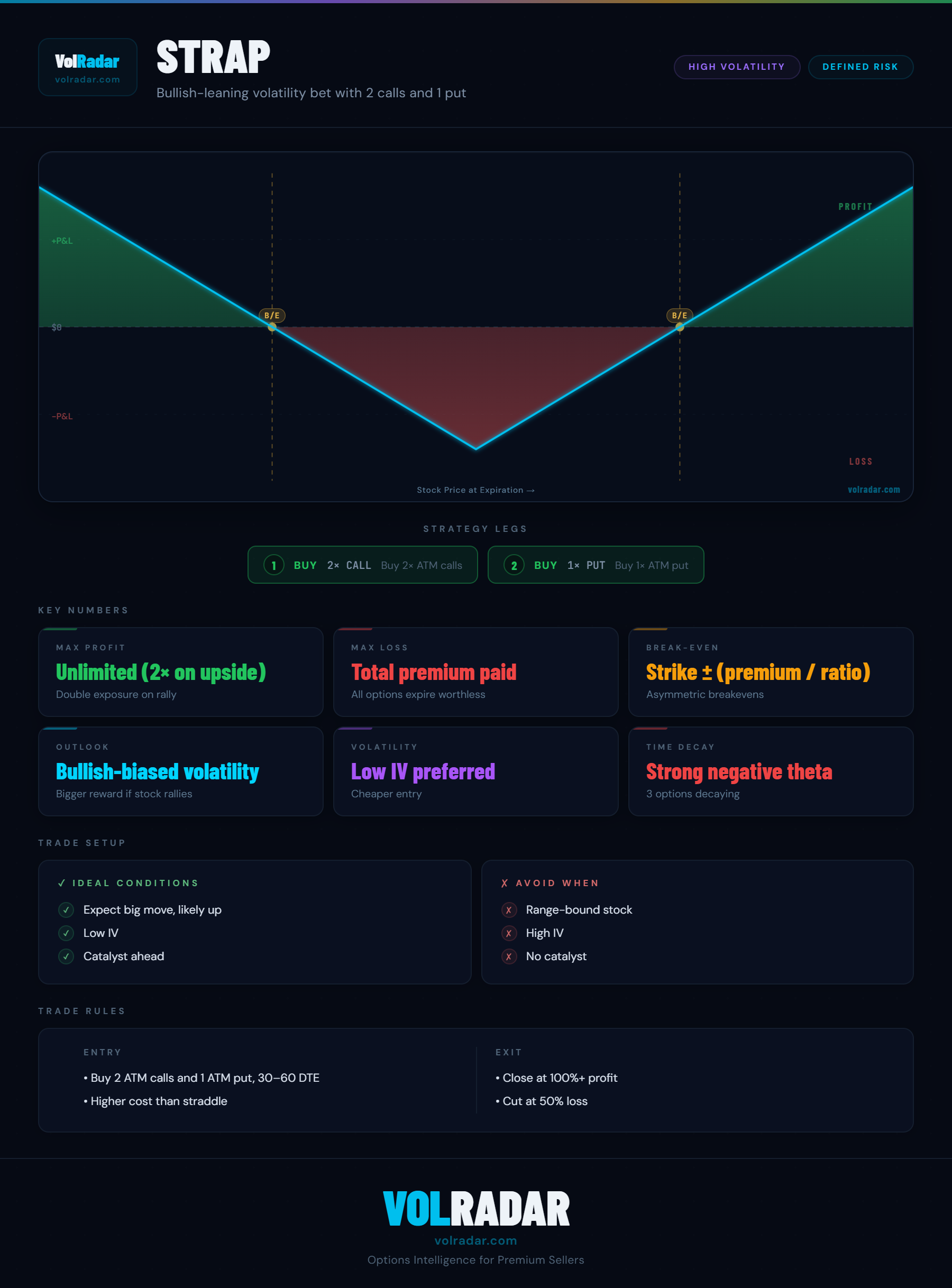
A strap buys two calls and one put with the same strike and expiration, a long straddle tilted toward a rise.
By Aigars PilmanisLast updated
Educational content. Not financial, investment, tax, or legal advice. Options involve risk and are not suitable for all investors. How we write & review this glossary.
Read the full guide
Strap Options Strategy — Bullish Volatility Play with Extra Call
A strap buys 2 ATM calls and 1 ATM put — a straddle skewed bullish. Why traders use it before positive-catalyst events and how the cost compares to a standard straddle.
Read the guide→A strap is a long options position that buys two calls and one put on the same underlying with the same strike and expiration. It is a long straddle with an extra call: it profits from a large move in either direction, but a rise pays about twice as much per dollar as a fall of the same size.
Video explainer6:20
Watch: Strap Explained
6:20 walkthrough — definition, mechanics, worked example, and common mistakes for Strap.
What to remember from this video
The strap strategy is a bullish-biased long straddle, doubling upside exposure with two calls while maintaining downside protection with one put.
Key Insights From The Video
- Strap involves buying two calls and one put at the same strike and expiration.
- The 2-to-1 call-to-put ratio tilts the strategy bullish.
- Upside breakeven is strike plus half the total debit.
- Downside breakeven is further away due to higher premium.
- Strap costs more than a straddle due to three option legs.
Read the complete video explanation~263 words · 1 min read
The strap strategy is a specialized options play for traders anticipating a significant upward move in a stock. It involves buying two calls and one put at the same strike price and expiration, effectively tilting a standard straddle towards a bullish outlook. This setup provides double the upside exposure compared to a traditional straddle, while still offering downside protection through the single put option.
To construct a strap, you purchase two at-the-money calls and one at-the-money put. This 2-to-1 ratio indicates a strong belief in an upward breakout, while the put acts as a safety net against a potential downturn. The key advantage of this strategy is its ability to accelerate profits on upward moves, as each dollar increase in the stock price benefits from two call contracts.
The cost of implementing a strap is higher than a simple straddle due to the additional call option. This means the initial premium paid is greater, raising the upside breakeven and moving the downside breakeven further below the strike. For the upside, the breakeven is the strike price plus half of the total premium, as the two calls share the cost burden.
On the downside, the breakeven is further away because the single put must recover the entire premium if the stock drops. Despite this, the put provides meaningful protection against significant losses, though a larger decline is necessary to achieve profitability on the downside.
A strap benefits from a large move, particularly to the upside, and its premium is higher than a straddle's, so the stock must move enough to cover the larger debit.
The position
Structure
A strap buys two calls and one put at the same strike
- Direction
- Bullish
- Drives outcome
- A move either way, with twice the call exposure on the upside.
- Risk type
- See structure
VolRadar Lens
The extra call moves the upside break-even closer but the downside break-even further away than a straddle's, because the single put has to recover the cost of all three options.
Why It Matters
A strap expresses two views at once: that the stock will move a lot, and that a rise is more likely or more important than a fall. Compared with a long straddle at the same strike it costs more, needs a smaller rise to break even and a larger fall. Compared with simply buying calls, the put limits how much a large fall costs, at the price of a higher debit. Its mirror image, two puts and one call, is called a strip.
How It Works
With strike K and a total debit D (two call premiums plus one put premium), the value at expiration is 2 x max(S - K, 0) + max(K - S, 0). Above the strike the two calls gain $2 for each $1 rise, so the upside break-even is K + D/2. Below the strike only the put pays, $1 for each $1 fall, so the downside break-even is K - D. The maximum loss is the whole debit, reached if the stock finishes exactly at the strike; the profit on the upside is unlimited in theory, and on the downside it is limited by the stock's fall to zero. Like a long straddle, the position loses value as time passes if the stock does not move, and it gains when implied volatility rises, other things equal.
Example
Hypothetical (Black-Scholes prices, which assume European-style exercise; American-style US equity options, especially puts, can be priced slightly higher because of early exercise; stock $100, 30 days, implied volatility 30%, interest 4%, no dividends, standard US equity options of 100 shares): buy two $100 calls at about $3.59 and one $100 put at about $3.26. Debit = 2 x 3.59 + 3.26 = $10.44 per share ($1,044). Break-evens: $100 + 10.44 / 2 = $105.22 and $100 - 10.44 = $89.56. At expiration: stock $115, value 2 x 15 = $30, profit $19.56 per share ($1,956); stock $85, value $15, profit $4.56 ($456); stock $100, all three expire worthless, loss $1,044.
Common Mistakes
Computing the upside break-even as strike plus the full debit; with two calls it is strike plus half the debit. Forgetting that the maximum loss, the whole debit, comes from the stock finishing exactly at the strike. Ignoring that implied volatility often falls after a scheduled event such as earnings, which can lower all three options' prices even when the stock moves. Treating the put as full protection: it pays as soon as the stock is below the strike, but the strap only shows a profit on a fall below K - D, where the put's payoff covers the cost of all three options.
Is the market paying premium sellers today?
The SPY Premium Window study tracks when systematic option selling has historically been compensated — recomputed daily from market close. Free to read, no account needed.
Frequently Asked Questions
What are the break-even points of a strap?
With strike K and total debit D, the upside break-even is K + D/2, because two calls gain together above the strike, and the downside break-even is K - D, because only the single put pays below it.
What is the difference between a strap and a strip?
Both are straddle variants with three options at one strike and expiration. A strap buys two calls and one put and leans toward a rise; a strip buys one call and two puts and leans toward a fall.
General references
General references for this topic area, not citations for the specific figures above. VolRadar is not affiliated with these organizations.
Visual ReferencePayoff structure and strike placementShowHide
The information about Strap above is for educational purposes only and is not financial advice. Read our full investment disclaimer.
Understand options faster.
One term, one worked example, one real ticker. Every Sunday. No jargon.
One email per week, no drip campaigns · Unsubscribe anytime