
What is a cash-secured put?
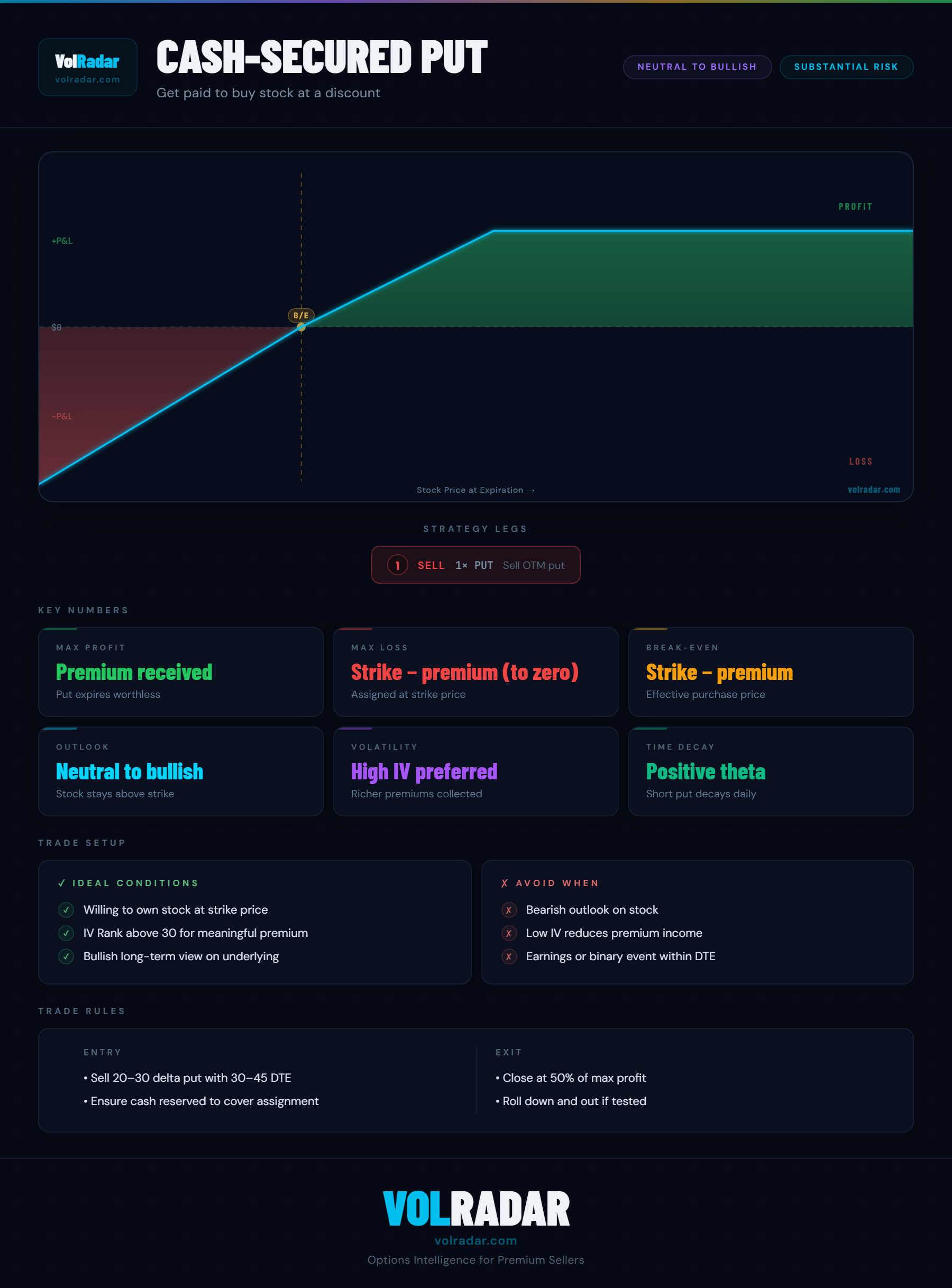
A cash-secured put is an options strategy where you sell a put option and hold enough cash in your account to purchase 100 shares at the strike price if the option is exercised. If the stock stays above your strike at expiration, the put expires worthless and you keep the premium. If the stock falls below your strike, you are assigned the shares at the strike price — but your net cost is reduced by the premium you collected.
How to set up a cash-secured put
Sell 1 put option on a stock you want to own, at a strike below the current price, with 21–45 DTE. Set aside the full cash to buy 100 shares at the strike. The 30-delta strike is standard: it offers a meaningful premium while giving the stock room to dip before assignment. With a $50 stock, a $45 strike CSP might collect $1.50 — your net acquisition price is $43.50 if assigned.
When to use a cash-secured put
The best time to sell cash-secured puts is when IV Rank is above 40 — elevated implied volatility means richer premiums. Sell puts on stocks you genuinely want to own, not just to collect premium on names you would not want to hold. Avoid CSPs before earnings announcements when a large gap down could push shares well below your strike. The Wheel Strategy cycles between CSPs and covered calls on the same stock.
Risk and reward
Max profit is the premium collected. Max loss is the strike price minus the premium — equivalent to buying the stock at a discount and having it go to zero. The risk is the same as owning the shares outright at a lower cost basis. Unlike a covered call, there is no upside participation — you collect fixed premium regardless of how high the stock goes. Cash-secured puts and covered calls have the same theoretical risk and reward profile.