
What is IV Percentile?
IV Percentile counts the number of trading days over the past year where implied volatility was lower than the current reading, then expresses that as a percentage of total trading days. An IV Percentile of 80 means IV was below today's level on 80% of the past 252 trading days. The metric treats each day equally, making it a distribution-based measurement rather than a range-based one.
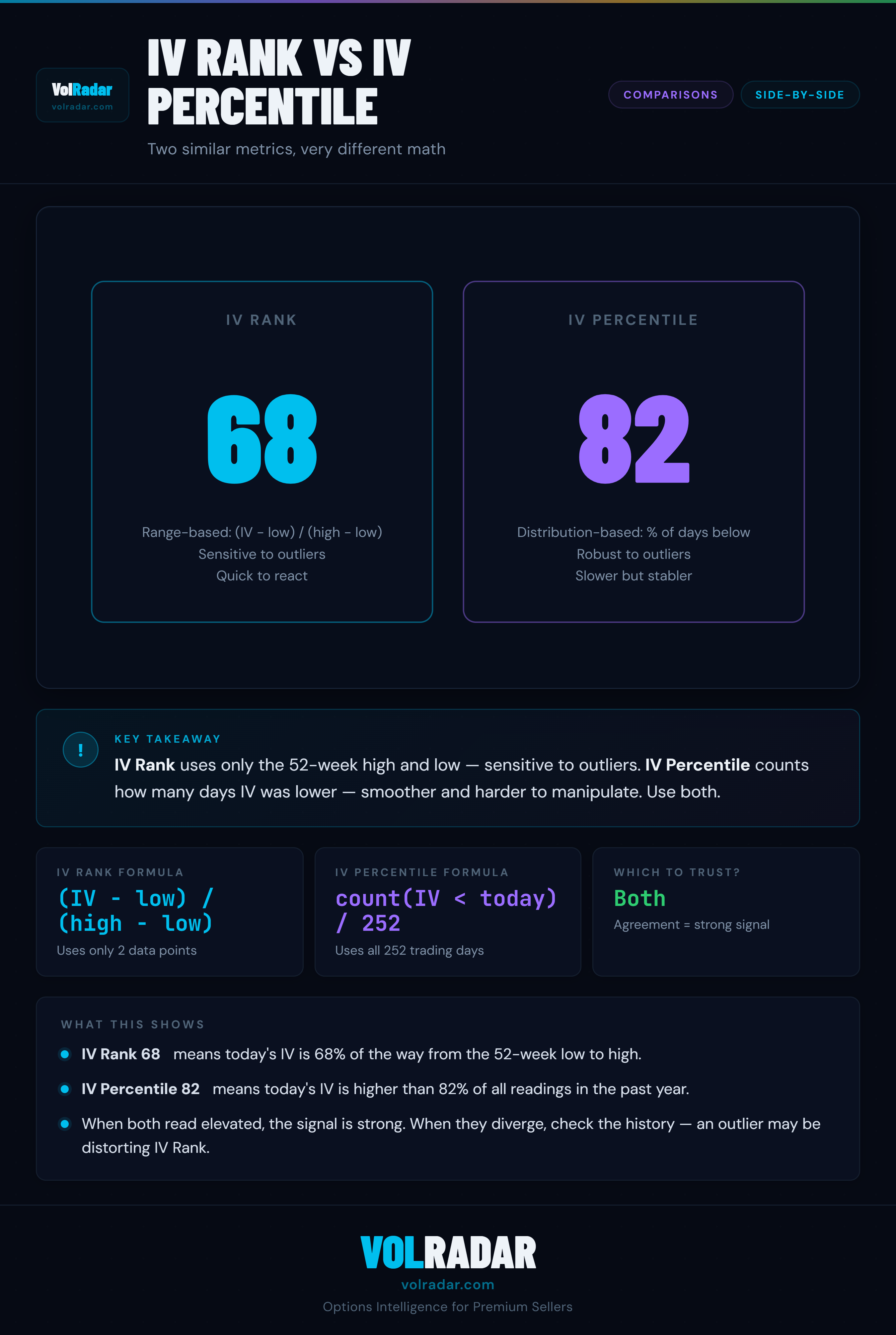
IV Percentile vs IV Rank
The key difference is sensitivity to outliers. IV Rank = (Current − Low) / (High − Low) × 100 — two data points drive the entire scale. IV Percentile counts all 252 days, weighting each equally. If a stock had a single IV spike to 80% six months ago but normally trades 20–30%, IV Rank stays near zero for months (because 30% is still near the low of the 20–80% range). IV Percentile recovers faster because it simply counts days. Use both as cross-validation.
When to prefer one over the other
Use IV Rank as your default filter: it is the standard industry metric and responds quickly to recent IV changes. Use IV Percentile as a sanity check — especially for stocks with a history of volatility spikes (biotech with FDA events, small caps with earnings gaps). When IV Rank and IV Percentile agree, the signal is strong. When they diverge significantly (more than 20 points), an outlier is distorting IV Rank and IV Percentile is more trustworthy.
Practical interpretation
IV Percentile 70 means current IV is higher than it was on 70% of past trading days — options are historically rich. IV Percentile 30 means IV was higher than today on 70% of days — options are historically cheap. For premium selling, aim for IV Percentile above 50 (at least the upper half of the year) with a clear trend. Combine with positive VRP to confirm that the elevated IV is not simply matching elevated realised vol.