
What is IV Rank?
IV Rank is a normalisation metric that places today's implied volatility on a 0–100 scale relative to its own 52-week high and low. The calculation is straightforward: subtract the 52-week low IV from the current IV, divide by the 52-week range (high minus low), and multiply by 100. An IV Rank of 70 means current IV is 70% of the way between the 52-week floor and ceiling — in the upper third of its annual range.
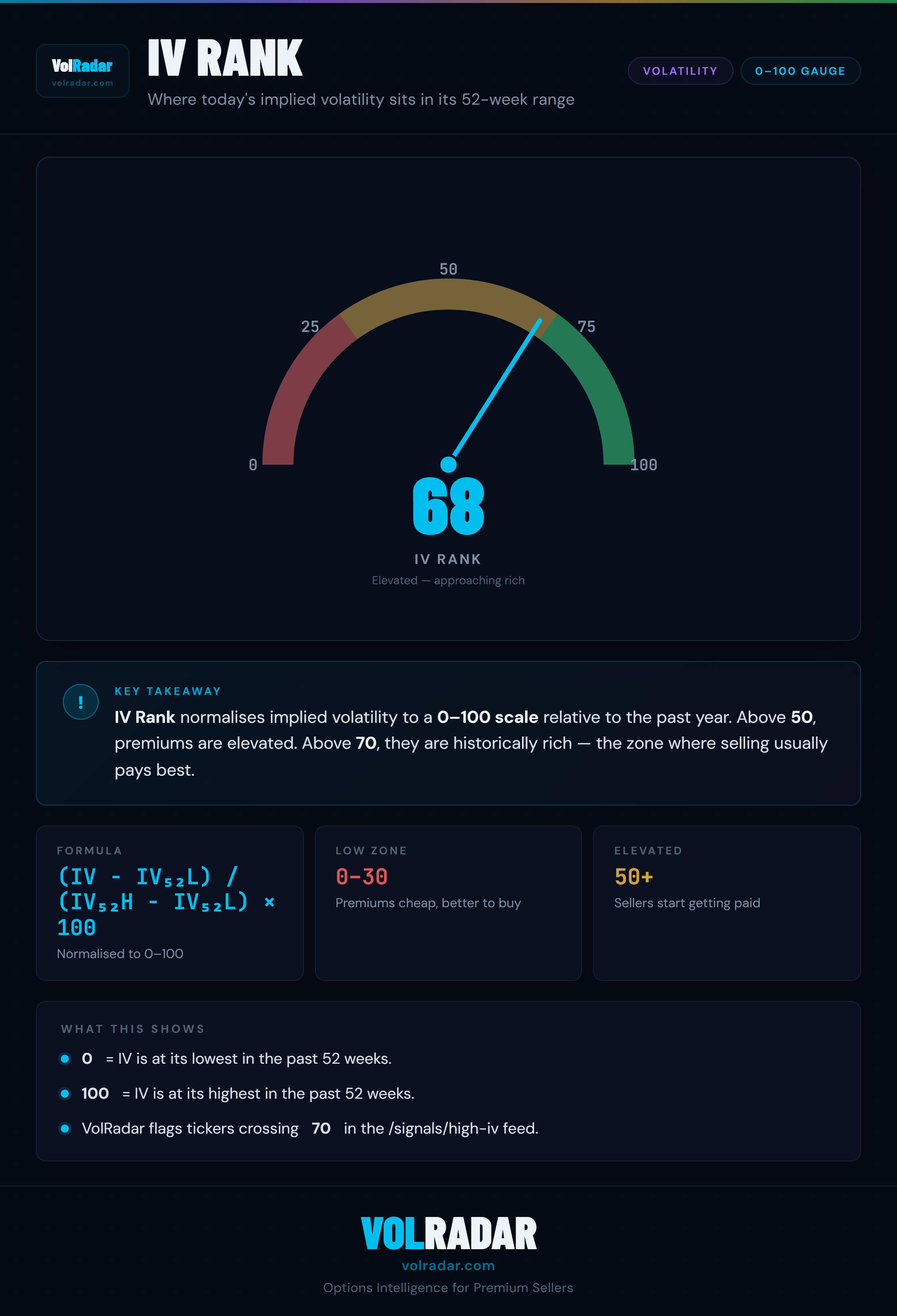
IV Rank thresholds
Below 30: IV is cheap — not ideal for selling premium, consider waiting or buying options. 30–50: Below-average premium — acceptable for selective trades with strong confluence. 50–70: Elevated — prime conditions for premium selling, focus capital here. Above 70: Very high — lucrative but risky, use defined-risk strategies and smaller size. These thresholds are guidelines, not absolutes; always combine IV Rank with VRP and RV Ratio.
Why IV Rank matters
Raw IV is hard to compare across stocks. A 25% IV is low for TSLA but high for KO. IV Rank normalises this by comparing each stock to its own history. When you see IV Rank 70 on any ticker, you know its options are historically expensive for that specific stock. This makes IV Rank the most practical first filter for premium selling: find stocks where options are priced above their historical norm, then confirm the edge with VRP and other signals.
IV Rank limitations
IV Rank uses only two data points from the 52-week window — the high and the low. A single extreme spike six months ago can compress the entire scale, making current moderately elevated IV appear low. For a more robust reading, check IV Percentile (which counts how many days IV was lower) alongside IV Rank. When both read elevated, the signal is strong. When they diverge, investigate: an outlier spike may be distorting IV Rank.