
What is VRP?
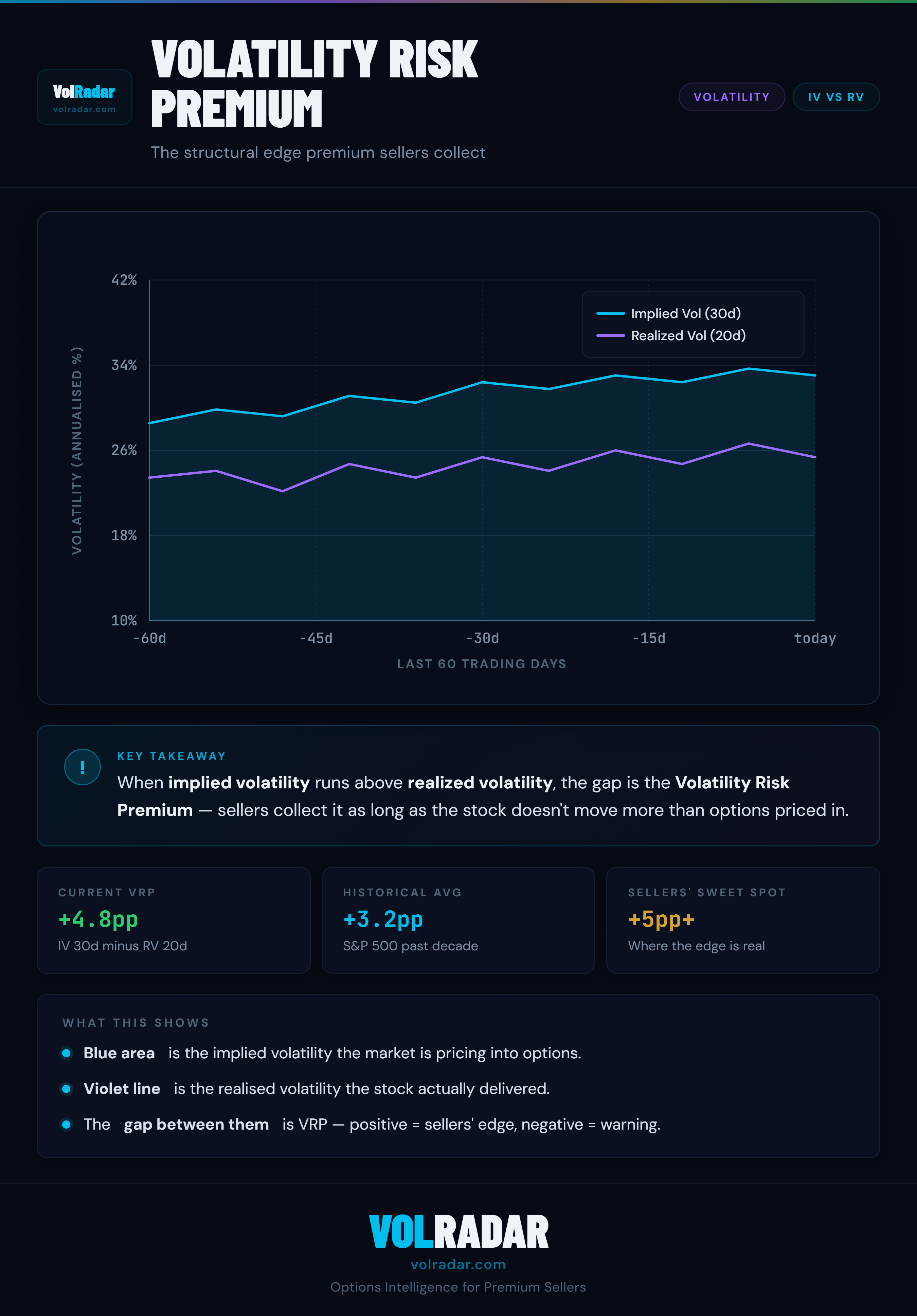
The Volatility Risk Premium is the persistent gap between what options cost (implied volatility) and what the underlying stock actually does (realised volatility). Because option buyers pay a premium for protection against tail risk, implied volatility tends to exceed realised volatility across most market conditions and stocks. That persistent overpricing is the VRP, and it is what makes premium selling a positive-expectancy strategy over time.
How to calculate VRP
VolRadar computes VRP as IV 30d minus HV 20d (using ORATS close-to-close historical volatility), expressed in percentage points. Example: if IV 30d is 28% and HV 20d is 22%, VRP is +6pp — meaning options imply 6 percentage points more annualised volatility than the stock actually delivered. Positive VRP favours sellers; negative VRP means options are underpriced and selling has no edge.
Using VRP for trade selection
Check VRP before every premium selling trade. Below 0pp: options are underpriced, skip the trade. 0–2pp: edge is thin, trade only with very high confluence. 2–5pp: workable setup, size standard positions. Above 5pp: strong edge, this is where you want to focus capital. Above 10pp: exceptional, verify no upcoming earnings or binary events are distorting IV. Combine VRP with IV Rank (want 50+) for the ideal setup.
VRP vs IV Rank
IV Rank tells you options are expensive relative to their own history. VRP tells you options are overpriced relative to the stock's actual movement. The two measure different things and both matter. An IV Rank of 80 on a stock that actually moves a lot (high RV) might show negative VRP — elevated IV is matched by elevated reality, no edge. The best setups combine high IV Rank (rich premiums) with strong positive VRP (overpricing relative to realised).