Loading...
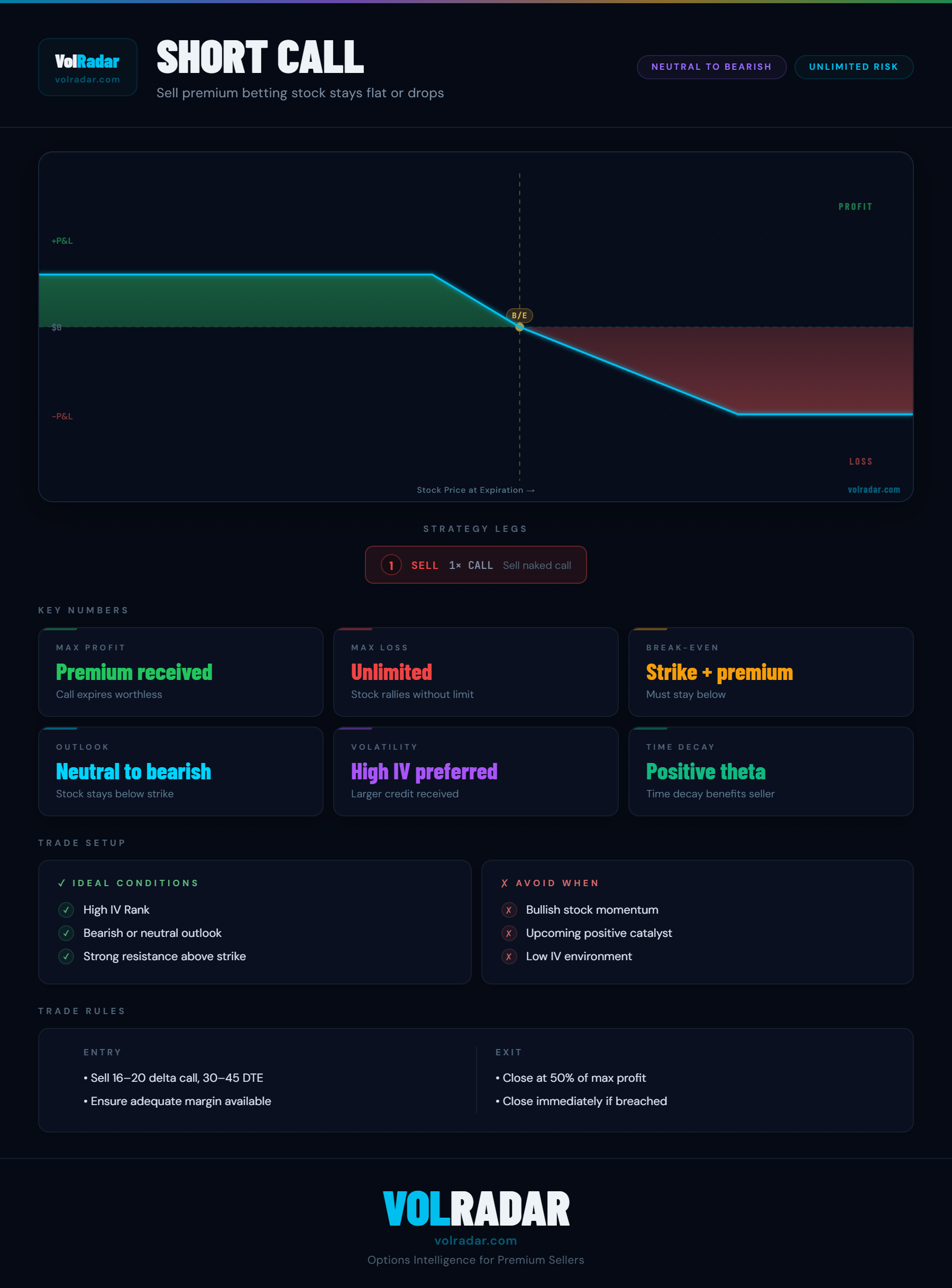
Selling a call option without owning the underlying shares. Theoretically unlimited risk since the stock can rise without bound. Requires high margin and active management.
⚡
Key takeawayThe riskiest single-leg option trade. Most premium sellers use defined-risk alternatives (call spreads, iron condors) instead.
💡 Why It Matters
The naked call is the riskiest single-leg options trade — unlimited theoretical loss because a stock can rise without bound. Most premium sellers avoid naked calls entirely, preferring call credit spreads or covered calls for bearish/neutral exposure.
⚙ How It Works
Sell a call without owning the underlying shares. If the stock stays below the strike, keep the premium. If the stock rises above the strike, you're obligated to sell shares you don't own — buying at market and delivering at the strike. Loss = (market price − strike − premium) × 100.
📋 Example
SPY at $580. Sell the $600 call for $1.50. SPY rallies to $620. Your loss: ($620 − $600 − $1.50) × 100 = $1,850 per contract. If SPY goes to $650: $4,850 loss. No upper bound. Compare to a $600/$605 call spread: max loss capped at $350 regardless of SPY price.
⚠ Common Mistakes
Selling naked calls on momentum stocks because the premium looks attractive. A stock that can gap 15% overnight (earnings, takeover, short squeeze) creates a loss that no amount of premium income can offset. Use call spreads for defined risk.
❓ FAQ
What is Naked Call?
Selling a call option without owning the underlying shares. Theoretically unlimited risk since the stock can rise without bound. Requires high margin and active management.
Why does Naked Call matter for premium sellers?
The riskiest single-leg option trade. Most premium sellers use defined-risk alternatives (call spreads, iron condors) instead.
How does Naked Call work?
Sell a call without owning the underlying shares. If the stock stays below the strike, keep the premium. If the stock rises above the strike, you're obligated to sell shares you don't own — buying at market and delivering at the strike. Loss = (market price − strike − premium) × 100.
What are common mistakes with Naked Call?
Selling naked calls on momentum stocks because the premium looks attractive. A stock that can gap 15% overnight (earnings, takeover, short squeeze) creates a loss that no amount of premium income can offset. Use call spreads for defined risk.
Related Terms
Albatross Spread
A very wide iron condor where the short strikes are far OTM and the wings are far apart.
Bear Call Ladder
Sell one lower-strike call, buy one middle-strike call, buy one higher-strike call.
Bear Call Spread
A bearish credit spread that sells a lower call and buys a higher call, collecting premium if the stock stays below the short strike.
Bear Put Ladder
Sell one higher-strike put, buy one middle-strike put, buy one lower-strike put.
This is not financial advice. Read our full investment disclaimer.