Loading...
Strategies
Reverse Iron Butterfly — Options Strategy Explained
A reverse iron butterfly buys an at-the-money straddle and sells out-of-the-money wings: a debit trade that profits from a large move either way.
By Aigars PilmanisLast updated
Educational content. Not financial, investment, tax, or legal advice. Options involve risk and are not suitable for all investors. How we write & review this glossary.
A reverse iron butterfly is an options strategy that buys an at-the-money call and put and sells an out-of-the-money call and put equidistant from the middle strike, all with the same expiration. It is paid for with a net debit, profits when the stock moves far from the middle strike in either direction, and loses at most the debit if the stock finishes at the middle strike. The Options Industry Council calls this structure a long iron butterfly.
The position
Structure
A reverse iron butterfly buys an at-the-money straddle and sells an out-of-the-money strangle, for a net debit.
- Direction
- Volatility play
- Drives outcome
- Maximum profit when the stock moves far from the center
- Risk type
- Defined risk
VolRadar Lens
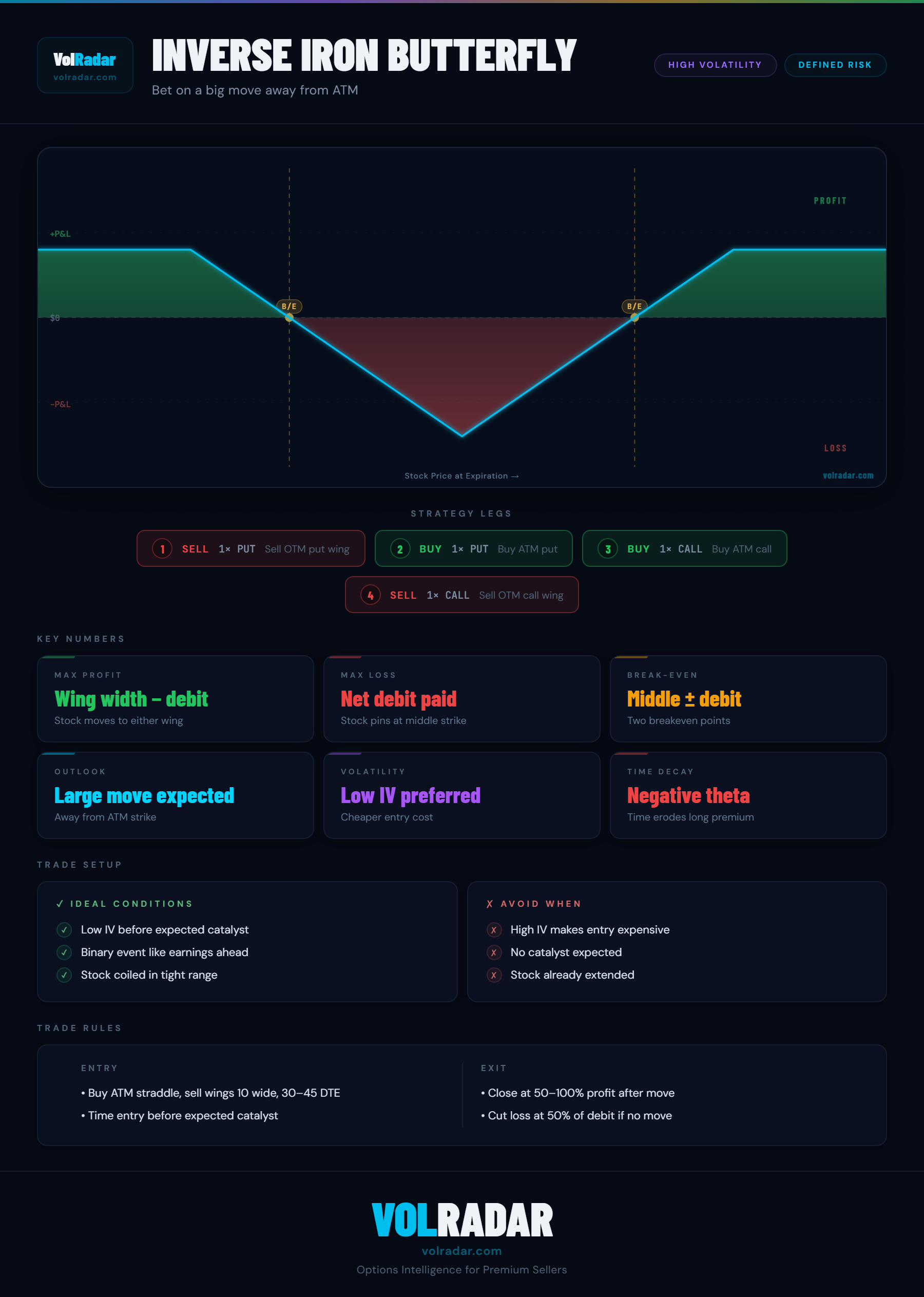
A reverse iron butterfly is a defined-risk bet on a large move. Maximum loss is the debit paid; with equal-width wings, maximum gain is the wing width minus that debit, reached beyond either wing at expiration.
Visual ReferencePayoff structure and strike placementShowHide
Why It Matters
The reverse iron butterfly expresses a view that the stock will move a lot without choosing a direction, with both the cost and the gain known in advance. Compared with buying the straddle alone, selling the wings lowers the debit and moves the breakevens closer, at the price of capping the gain. It is often discussed around scheduled events such as earnings, where the direction is unknown. The catch is that option prices before such events already reflect an expected move, and implied volatility can fall once the news is out, so the stock has to finish beyond one of the breakevens (the middle strike plus or minus the debit) for the trade to profit at expiration, and a fall in implied volatility can cut its value before then.
How It Works
Buy one call and one put at the middle strike, usually near the current price, then sell one call at a higher strike and one put at a lower strike, the same distance away, all in the same expiration. The two short wings reduce the cost of the long straddle but cap the gain. According to the Options Industry Council, the maximum gain is the distance from the middle strike to a wing minus the net premium paid, reached if the stock is outside the wings at expiration; the maximum loss is the premium paid, reached if the stock is at the middle strike; and the two breakevens are the middle strike plus and minus the premium paid. The same source notes that a rise in implied volatility helps the position and that the passage of time hurts it, because the trader is a net buyer of premium. The mirror-image trade, the iron butterfly, sells the middle strike for a credit and profits when the stock stays near it.
Example
Hypothetical: with the stock at $100 and 7 days to expiration, you buy the $100 call and $100 put and sell the $105 call and $95 put for a net debit of $2.20 ($220 per structure on standard 100-share contracts). Breakevens are $100 - $2.20 = $97.80 and $100 + $2.20 = $102.20. If the stock closes at $107, the $100 call is worth $7, the short $105 call costs $2 and both puts expire worthless: $7 - $2 - $2.20 = $2.80, or $280, which is also the maximum gain ($5 wing width - $2.20). If the stock closes at $100, every option expires worthless and the loss is the full $220.
Common Mistakes
Treating a large move as enough. The move has to exceed the breakevens by expiration, and a drop in implied volatility after an event can shrink the position's value even when the stock moves. Forgetting that the gain is capped at the wings: a very large move earns no more than a move just beyond a wing. Ignoring time decay: all else equal, the position loses value as time passes while the stock stays near the middle strike. Ignoring early assignment: the short wings are American-style on US equity options and can be assigned before expiration once they are in the money.
Comparison
Reverse iron butterfly versus long straddle: the straddle has no cap on the gain but costs more and needs a larger move to break even. Reverse iron butterfly versus iron butterfly: the iron butterfly is the opposite trade, a credit that profits if the stock stays near the middle strike. Reverse iron butterfly versus reverse iron condor: the condor buys a strangle instead of a straddle, which is cheaper but needs a larger move.
Is the market paying premium sellers today?
The SPY Premium Window study tracks when systematic option selling has historically been compensated — recomputed daily from market close. Free to read, no account needed.
Frequently Asked Questions
What is a reverse iron butterfly?
It buys an at-the-money call and put and sells an out-of-the-money call and put the same distance from the middle strike, all in the same expiration. It is a net debit that profits from a large move in either direction.
What is the maximum profit and loss?
With equidistant wings, maximum profit is the wing width minus the debit paid, reached beyond either wing at expiration. Maximum loss is the debit, reached if the stock finishes at the middle strike.
Where are the breakevens?
At the middle strike plus and minus the debit paid. With a $100 middle strike and a $2.20 debit, they are $97.80 and $102.20.
How is it different from a long straddle?
Selling the wings lowers the cost and brings the breakevens closer, but it caps the gain. A straddle has no cap on the gain but costs more.
How do volatility and time affect it?
It is a net long premium position: rising implied volatility helps it and the passage of time hurts it, all else equal.
General references
General references for this topic area, not citations for the specific figures above. VolRadar is not affiliated with these organizations.
The information about Reverse Iron Butterfly above is for educational purposes only and is not financial advice. Read our full investment disclaimer.
Understand options faster.
One term, one worked example, one real ticker. Every Sunday. No jargon.
One email per week, no drip campaigns · Unsubscribe anytime