Loading...
Strategies
Short Call Condor — Options Strategy Explained
A short call condor sells the lowest and highest call strikes and buys the two middle ones; with equal wing widths it profits if the stock finishes outside the outer strikes.
By Aigars PilmanisLast updated
Educational content. Not financial, investment, tax, or legal advice. Options involve risk and are not suitable for all investors. How we write & review this glossary.
Read the full guide
Short Call Condor — Profit from a Large Move Using Only Calls
A short call condor sells the outer call strikes and buys the inner ones — a defined-risk position that profits on a large move in either direction. How it compares to a long strangle, and when the credit beats a debit straddle.
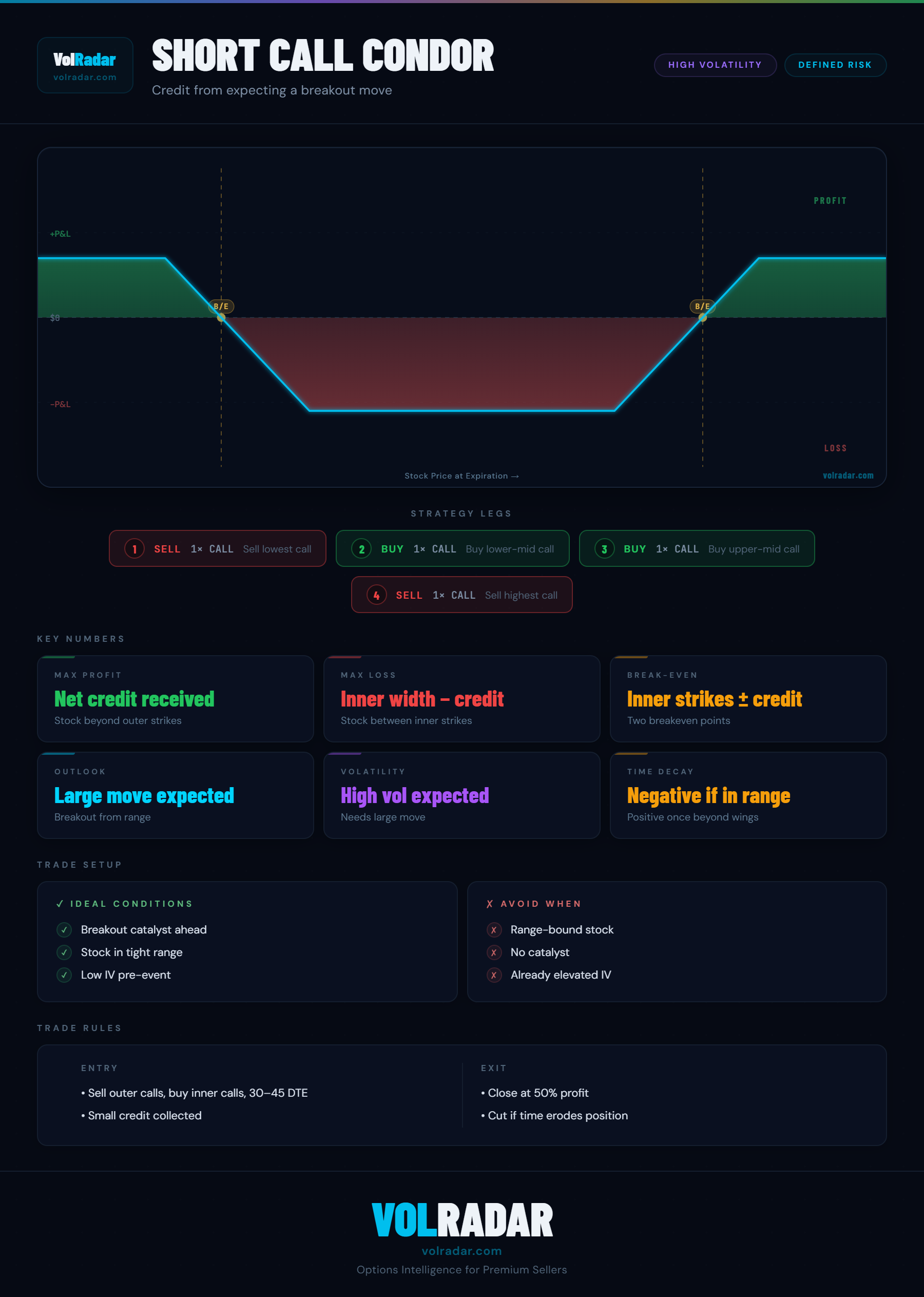
Read the guide→A short call condor is a four-strike, all-call position with one expiration: sell one call at the lowest strike, buy one call at each of the two middle strikes, and sell one call at the highest strike. It is the reverse of a long call condor, opens for a net credit, and, with equal wing widths, profits at expiration if the stock finishes outside the outer strikes, while the maximum loss occurs between the two middle strikes.
The position
Structure
A short call condor sells one lower-strike call, buys two middle-strike calls, and sells one upper-strike call.
- Direction
- Volatility play
- Drives outcome
- A defined-risk volatility bet expecting breakout from a range, with profit depending on the breakevens and outer strikes at expiration.
- Risk type
- Defined risk
VolRadar Lens
Both the gain and the loss are capped, and with equal wing widths the maximum loss is the distance between the lowest two strikes minus the credit, so the payoff is decided by where the stock settles relative to four strikes, not by how far it moves beyond them.
Visual ReferencePayoff structure and strike placementShowHide
Why It Matters
The short call condor is a defined-risk way to position for a move away from a range without owning a straddle or strangle outright: it receives a credit instead of paying a debit, but it gives up any gain beyond the outer strikes. When the lowest strike is in the money, as in the example, that short call carries early-assignment risk, especially before an ex-dividend date.
How It Works
With strikes K1 < K2 < K3 < K4 and equal wing widths (K2 - K1 = K4 - K3), the position is short K1, long K2, long K3 and short K4. It can be read as a bear call spread (short K1, long K2) combined with a bull call spread (long K3, short K4). Below K1 at expiration all four calls expire worthless and the trader keeps the credit. Above K4, the gains and losses on the four calls offset and the trader also keeps the credit. Between K2 and K3 the loss is at its maximum: the K1-K2 spread is worth its full width and the upper calls are worthless or offsetting, so the maximum loss equals K2 - K1 minus the credit. The break-evens are K1 plus the credit and K4 minus the credit. If the stock is between the two middle strikes when the position is opened, an increase in implied volatility generally helps it before expiration, the mirror of OIC's note for a long call condor; OIC adds that the effect depends on strike selection relative to the stock price. The short calls are American-style on US equity options and can be assigned early.
Example
Hypothetical (Black-Scholes prices, stock $100, 30 days, implied volatility 30%, interest 4%, no dividends, standard US equity options of 100 shares): sell the $90 call at $10.70, buy the $95 call at $6.65, buy the $105 call at $1.66, sell the $110 call at $0.66. Net credit = 10.70 - 6.65 - 1.66 + 0.66 = $3.05 per share ($305 per condor). At expiration: at or below $90 or at or above $110 the result is +$305; between $95 and $105 it is (95 - 90) - 3.05 = $1.95 per share loss, or -$195; break-evens are $90 + $3.05 = $93.05 and $110 - $3.05 = $106.95.
Common Mistakes
Confusing it with a short iron condor, which sells the inner strikes and profits if the stock stays in the range. Computing the maximum loss from the distance between the two middle strikes instead of between the lowest two. Using unequal wing widths without recomputing the payoff, which can leave risk above the top strike. Ignoring early assignment on the in-the-money short call.
Is the market paying premium sellers today?
The SPY Premium Window study tracks when systematic option selling has historically been compensated — recomputed daily from market close. Free to read, no account needed.
Frequently Asked Questions
What is the maximum profit and loss of a short call condor?
With equal wing widths (the same distance between the lowest two and the highest two strikes), the maximum profit is the net credit, earned if the stock finishes at or below the lowest strike or at or above the highest strike. The maximum loss is the distance between the lowest two strikes minus the credit, incurred if the stock finishes between the two middle strikes.
How is a short call condor different from a short iron condor?
A short call condor uses only calls, sells the outer strikes and buys the inner ones, and, with equal wing widths, makes money on a move outside the outer strikes. A short iron condor sells an inner call and an inner put and buys outer protection, and makes money if the stock stays between the short strikes. Their payoffs are roughly opposite.
General references
General references for this topic area, not citations for the specific figures above. VolRadar is not affiliated with these organizations.
The information about Short Call Condor above is for educational purposes only and is not financial advice. Read our full investment disclaimer.
Understand options faster.
One term, one worked example, one real ticker. Every Sunday. No jargon.
One email per week, no drip campaigns · Unsubscribe anytime