
What is a short call condor?
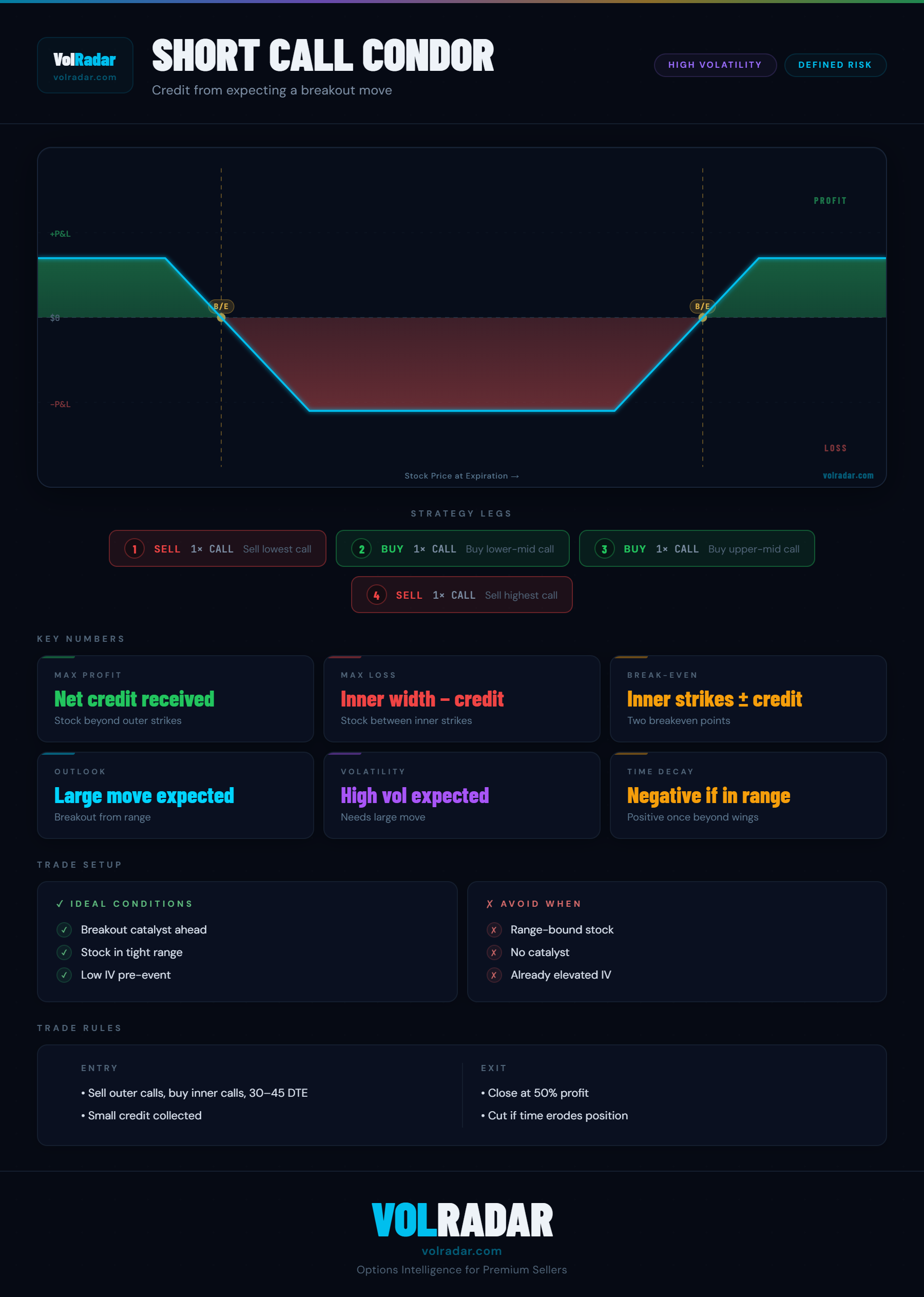
A short call condor reverses the long call condor: sell the outer calls (lower and higher strikes) and buy the inner calls (two middle strikes). You collect a net credit because the outer short calls are worth more than the inner long calls. The position profits when the stock moves significantly in either direction beyond the profit threshold. Max loss occurs when the stock stays between the inner short strikes.
Short call condor vs long strangle
A long strangle buys OTM options on both sides for a debit — unlimited profit potential on large moves. A short call condor collects a credit but caps the profit. For defined-risk volatility plays where you want to limit the cost, the short condor is more capital efficient but requires a specific magnitude of move to reach full profit. The defined wings prevent catastrophic loss.
When to use a short call condor
Use a short call condor when you expect a large directional move but want to control risk with defined maximum loss. It works best before catalysts (earnings, product approvals, FOMC) when you expect a significant but bounded move. The credit collected reduces the breakeven threshold. Use the Expected Move Calculator to ensure your inner strikes are inside the expected move range.
Risk and reward
Max profit is the credit collected, achieved when the stock moves beyond either outer wing. Max loss is the inner spread width minus the credit. Unlike most premium selling strategies, the short condor is a directional volatility strategy — you want the stock to move, not stay still. Position at inner strikes near the expected range and outer strikes where the stock realistically might reach.