
What is a long combo?
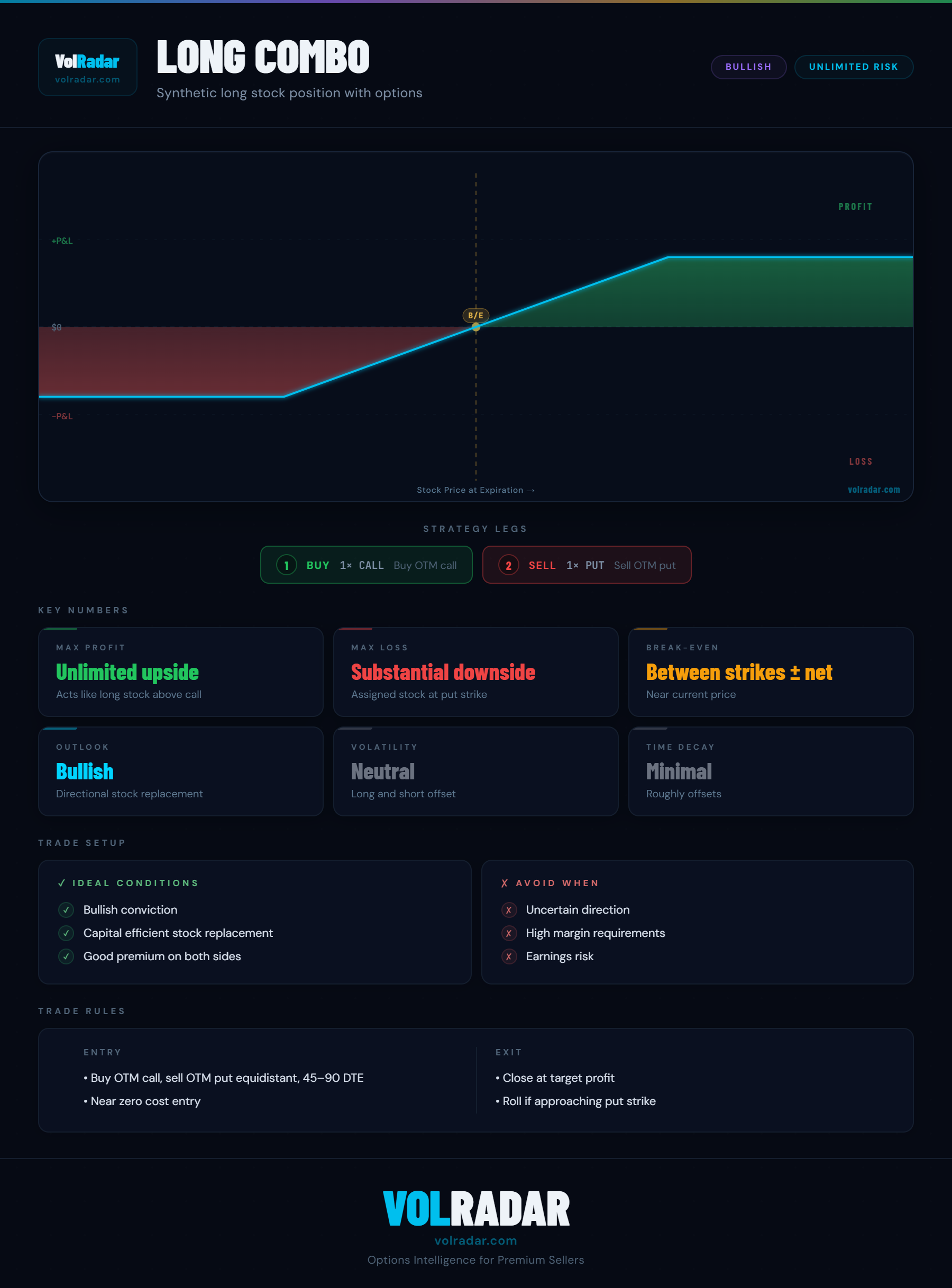
A long combo buys 1 OTM call at a higher strike and sells 1 OTM put at a lower strike. Both options are out-of-the-money at entry. The short put generates premium that funds the long call — the net cost can be zero or even a small credit. If the stock rises above the call strike, the call profits. If the stock falls below the put strike, the short put creates a loss equivalent to being long the stock at the put strike.
Long combo vs long synthetic future
A long synthetic future uses ATM strikes on both legs — immediate delta exposure, replicates stock closely. A long combo uses OTM strikes — a buffer zone between the two strikes where no significant gain or loss occurs. The combo is preferred when you want directional exposure but only want to participate in larger moves, not small fluctuations in either direction.
Risk reversal concept
The long combo is also called a risk reversal — it reverses the risk from the put side to the call side. Institutional traders use risk reversals to express bullish views at minimal cost while accepting downside risk via the short put. In equity markets, put skew typically makes short OTM puts rich — funding more of the long call cost.
Risk and management
The downside risk below the short put is equivalent to the stock itself — the put behaves like owning the stock below the strike. Position sizing should treat the notional value of the short put as the risk amount. The long call profit is capped only by the stock price going to infinity — theoretically unlimited upside. Monitor and close if the stock approaches the short put strike.