
What is a long synthetic future?
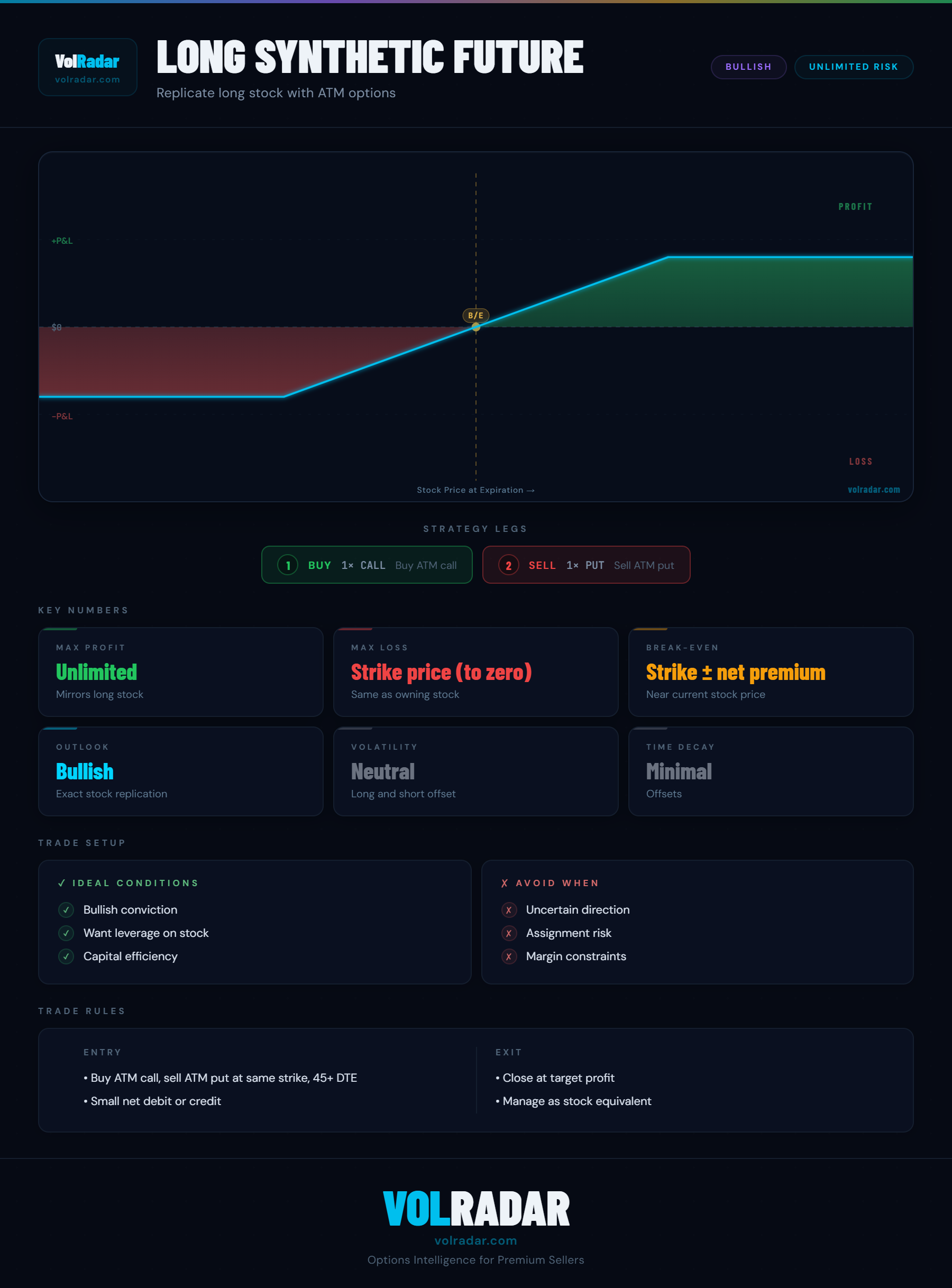
A long synthetic future buys 1 ATM call and sells 1 ATM put at the same strike and expiration. The combined position mimics owning 100 shares of the stock: it gains when the stock rises and loses when the stock falls, with the same linear relationship. The name "synthetic" means it synthetically replicates the stock position using options instead of purchasing the actual shares.
Long synthetic vs buying stock
Buying 100 shares requires the full capital outlay (e.g., $10,000 for a $100 stock). A long synthetic future requires margin for the short put — typically much less than the full share price. Capital efficiency is the primary advantage. Additionally, the synthetic can be placed at the same cost of carry as futures, making it useful for arbitrage. The risk is identical to owning the stock.
Risk and put-call parity
By put-call parity, a long call minus a short put at the same strike equals the stock position (adjusted for cost of carry). This relationship is fundamental to options pricing. If the stock falls below the put strike, you are assigned shares at the strike price (same as having owned them). The synthetic is not a lower-risk strategy — it is a capital-efficient replication of the same risk.
When to use a long synthetic
Synthetics are used by professional traders and institutions for capital efficiency, when stock is unavailable to borrow (hard-to-borrow names), or in futures and options markets where synthetic replication is more efficient. Retail traders may use a long synthetic as a capital-efficient way to gain stock exposure in a margin account. The short call equivalent (covered call on the synthetic) is also a common income strategy.