
What is a covered short strangle?
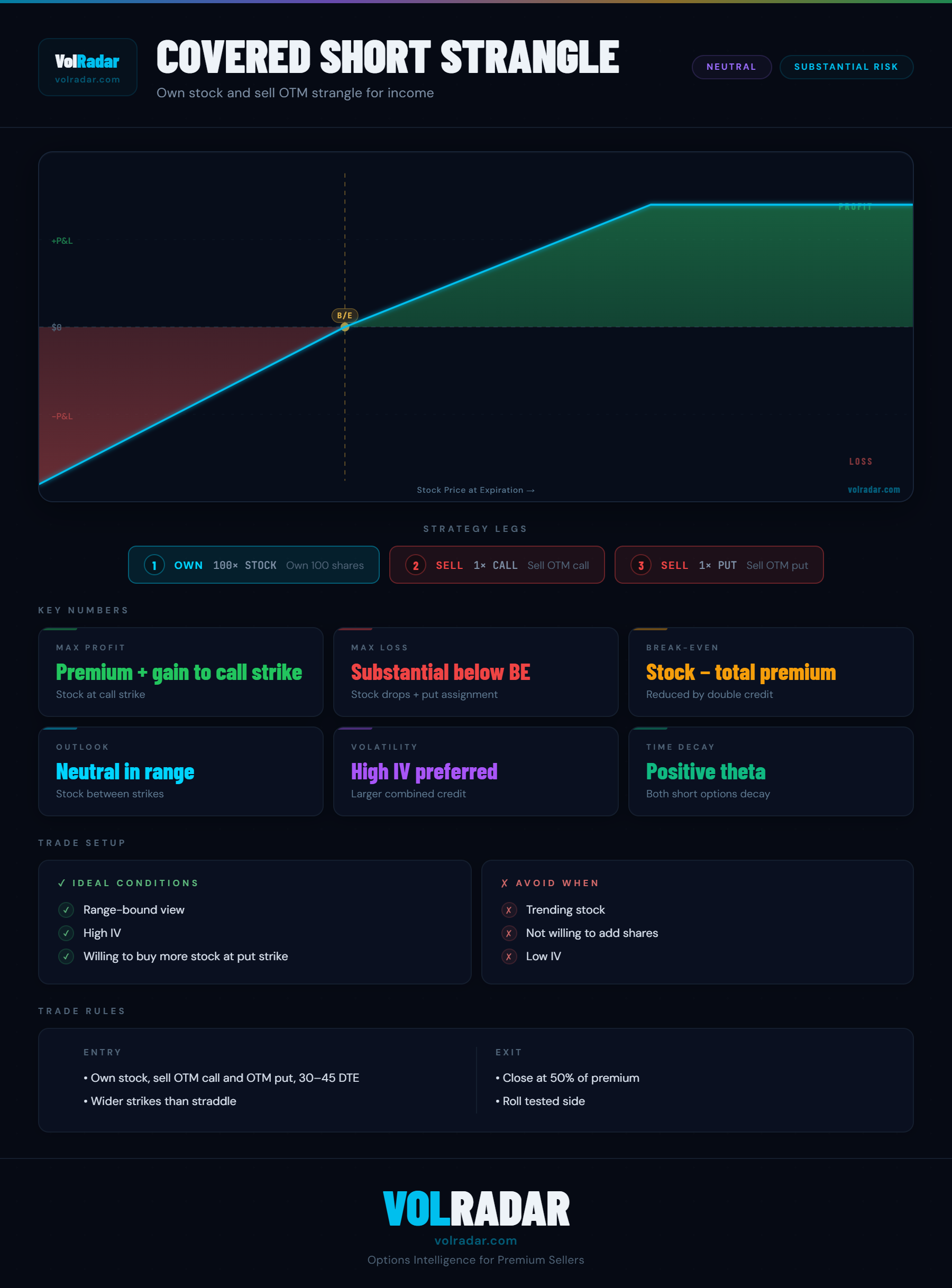
A covered short strangle owns 100 shares, sells an OTM call above the current price, and sells an OTM put below the current price. The OTM strikes mean both options are out-of-the-money at entry — giving the stock room to fluctuate without triggering assignment. You collect premium from both options. The call is covered by the shares; the put requires cash or margin backing.
Covered strangle vs covered call
A covered call generates income only from the short call. A covered strangle adds a short put, doubling the income source. The trade-off is the additional downside risk from the put. For a stock you believe will stay in a range, the covered strangle collects income from both direction bets simultaneously. The covered call is more appropriate for a slightly bullish outlook; the covered strangle suits a neutral, range-bound view.
Strike selection and income
Sell the call at the 25–30 delta level above the stock and the put at the 25–30 delta level below. Use IV Rank and the Expected Move Calculator to confirm both strikes are outside the 1σ range — that means each has approximately 75% probability of expiring OTM. Income should be meaningfully higher than a standalone covered call. Enter at 45 DTE and manage at 50% of total premium collected.
Risk and management
If the stock drops through the put strike: you are assigned an additional 100 shares (now hold 200) at a higher cost basis while stock is falling. This is the key risk. If the stock rallies through the call strike: shares called away at the strike price. Have a clear plan for both assignment scenarios before entering. Most traders prefer managing proactively (rolling the tested side) rather than accepting assignment.